Automatic fire suppression for electrical cabinets: 9 solutions compared
A fire usually starts inside the cabinet — in a closed, rarely monitored volume. Automatic suppression acts on the spot, without human intervention. This detailed comparison reviews nine solutions on the market — their technologies, strengths and weaknesses — including one often-overlooked criterion: detection speed.
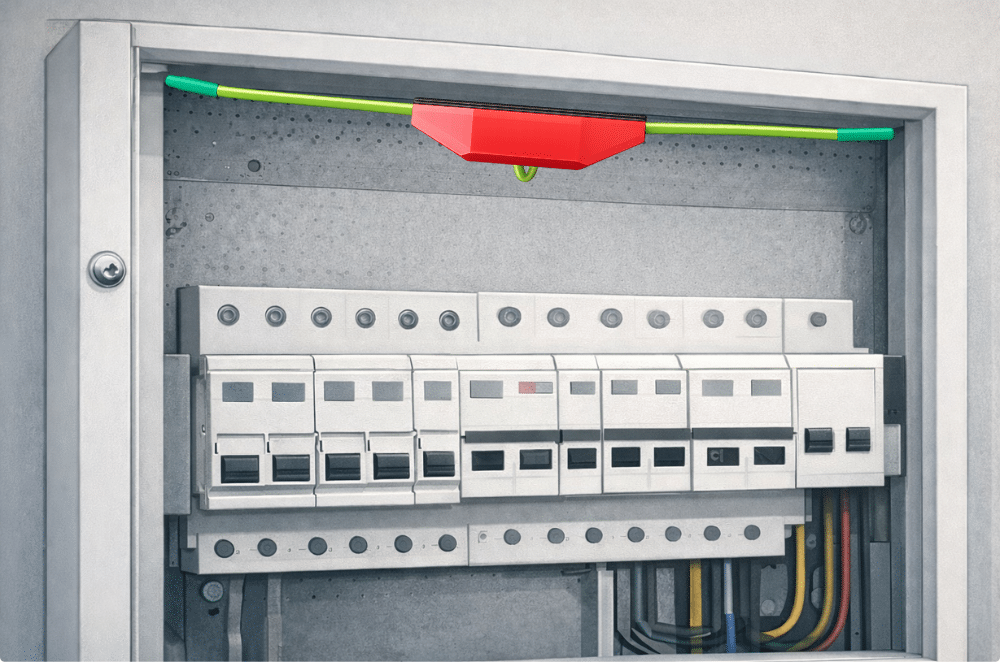
Automatic suppression acts directly inside the cabinet, as close as possible to the source.
What is automatic fire suppression?
An automatic suppression system detects a fire at its earliest stage and releases an extinguishing agent without human intervention. In an electrical cabinet, it acts within a closed volume where the incident almost always begins as a localised overheating.
Electrical faults remain a leading cause of fires. According to the Paris Fire Brigade, at least one third of domestic fires are of electrical origin; France's National Electrical Safety Observatory (ONSE) puts the share between 20 and 35%. Cabinets and distribution boards are among the most common ignition points.
Sources: Paris Fire Brigade (BSPP); French National Electrical Safety Observatory (ONSE), 2025.
Downtime
Production or services interrupted, business losses.
Material damage
Repair and replacement of equipment and premises.
Data loss
Possible destruction of critical information.
People's safety
Risk if the fire spreads to the room or building.
Three families of extinguishing agents
Before the detailed breakdown, here are the three main technologies used.
Inert gas
Argon, nitrogen or CO₂ smother the fire by reducing oxygen. Clean and residue-free, but often requires a sealed volume and dedicated installation.
Powder
Interrupts the combustion reaction. Effective, but can leave residues to clean on sensitive equipment.
Condensed aerosol
A fine-particle aerosol interrupts the fire's chemical reaction without reducing oxygen. Compact, no piping, ideal for small closed volumes.

Condensed aerosol principle: it interrupts the combustion reaction without depleting the oxygen in the volume.
The 9 fire suppression solutions for electrical cabinets
Each solution is presented in detail: technology and operation, strengths and points of caution, based on the information published by the manufacturers.
1. AF-X Fireblocker
A Dutch solution based on condensed aerosol with a modular approach to fire protection. Historically promoted for the validation of its generators, it targets industry, commercial buildings and certain vehicles, with the sector's standard certifications (ISO, EN).
Strengths
- Proven aerosol technology
- No piping required
- Lower maintenance than gas systems
Points of caution
- Fixed-threshold activation
- Integration complexity varies by model
- Faces more compact competitors
2. FireDETEC
A pneumatic detection tube filled with nitrogen is installed inside the cabinet. In a fire, the heat bursts the tube at the hottest point, triggering suppression. Direct or indirect installation, adaptable to various cabinet sizes.
Strengths
- Detection at the hottest point
- Direct in-cabinet installation
- Non-toxic agent, large installed base
Points of caution
- High purchase cost
- Annual maintenance
- Bulk and weight; certified installer required
3. FirePro
A condensed aerosol that acts directly on the fire's chemical reaction by neutralising free radicals, without reducing oxygen. Made from potassium salts, it covers a wide range of fire classes and claims a long service life. Multi-certified, targeting industry, commercial and transport.
Strengths
- Robust and multi-certified
- Clean, no toxic residue
- Compact design, long service life
Points of caution
- Fixed-threshold activation
- Higher price
- Specialised install, annual inspection
4. Amulette Feu
A standalone device for small spaces (cabinets, racks, server rooms). At a preset temperature (68 °C or 93 °C), a mechanism releases the NOVEC agent, an inert, residue-free fluid that preserves equipment. Screw-mounted, with no complex wiring.
Strengths
- Simple install, compact and standalone
- Thermal detection
- Residue-free agent
Points of caution
- Purchase cost and annual inspection
- 3M has announced the end of NOVEC fluid production
- Agent availability to anticipate
5. AeroXFireshield — AeroXSense
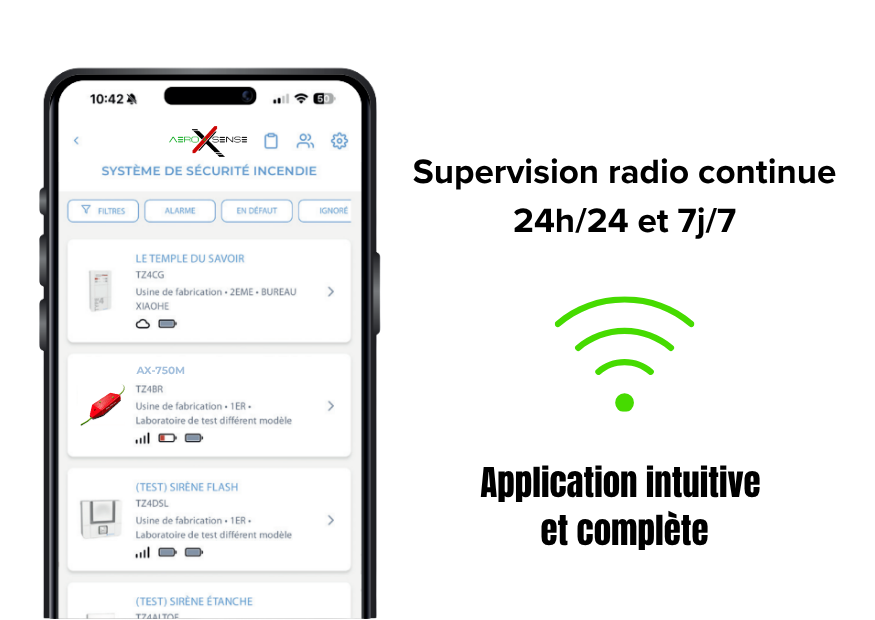
A condensed aerosol (potassium salts / strontium nitrate) made in France, available in three ranges: Residential, Pro and Industry. Its distinctive feature: a linear heat detection cable that reacts to the first hot spot in 2 to 3 seconds, without waiting for a global threshold. Connected (status reporting, power cut-off, radio) and with no heavy periodic maintenance for 5 years.
Strengths
- Linear detection in 2-3 s, at the earliest
- Made in France, clean condensed aerosol
- Ultra-compact, zero maintenance for 5 years
- Connected: status reporting, power cut-off, radio
Points of caution
- Beyond 8-9 m³, other solutions may fit better
- Connected offer is recent to market
6. ReflexOFeu
A system made of an agent tank placed outside the cabinet and a detection tube inside. Heat bursts the tube, releasing the non-corrosive, residue-free agent. The first system of its kind certified by ANPI.
Strengths
- Standalone, fast suppression
- Non-corrosive, residue-free agent
- ANPI certification
Points of caution
- Bulk: external tank
- Less suited to very tight spaces
- Cabinet access to preserve
7. TraceFlam
A system dedicated to professional deep fryers. A flexible heat-sensitive tube is installed near the fryer; on overheating it bursts and releases the agent at the source. Designed for the catering sector.
Strengths
- Immediate reaction, targeted suppression
- Non-corrosive agent
- Simple kitchen installation
Points of caution
- Dedicated to fryers — not suited to electrical use
- Annual maintenance
- Install by a certified professional
8. Firetrex
A standalone solution with a heat-sensitive polymer detection tube. On a temperature rise, the tube bursts and releases the agent (usually CO₂). Two modes: direct (the tube both detects and delivers the agent) or indirect (the tube detects, the agent is delivered separately).
Strengths
- Standalone, no external power needed
- Clean, non-corrosive agent
- Adaptable to several configurations
Points of caution
- Cost, long installation
- Bulk (tank) and weight
- Annual maintenance, qualified install
9. EXXFIRE
A high-end system for confined spaces. An aspirating unit monitors the air continuously; optical sensors detect smoke particles and software confirms the fire. Generators then release nitrogen to smother it.
Strengths
- Very fine multi-technology detection
- Inert nitrogen, safe for equipment
- Suited to critical environments (data centres)
Points of caution
- Install and maintenance by qualified technicians
- Sensitivity to false positives (dust, vapours)
- The most expensive solution in this comparison
AeroXFireshield: the French condensed aerosol — compact, connected and with linear detection
Available in three ranges — Residential, Pro and Industry — AeroXFireshield protects closed volumes with a focus on simplicity, economy and reactivity.
Residential
Distribution boards and small residential enclosures.
Pro
Professional enclosures and cabinets, greater capacity.
Industry
Cabinets, main switchboards and technical volumes, multi-generator architecture.
Custom
Layout, detection length and interfaces tailored to the project.
Made in France
French-origin certification on eligible references.
Connected
Status reporting, power cut-off and radio communication.
Zero maintenance 5 yrs
Controlled total cost of ownership.
Up to 8-9 m³
Series mounting; beyond that, we point to other solutions.
Detection speed changes everything
In a fire, every second counts. This is where detection technology makes the difference between a contained incident and a damaged cabinet.
Threshold activation
Aerosol solutions such as AF-X or FirePro generally rely on threshold activation: the device triggers once the temperature reaches its set point (around 60 °C). By the time the heat reaches that threshold, the fire has already had time to develop.
AeroXFireshield linear detection
The heat-sensitive cable runs along the whole volume and reacts to the first hot spot, in 2 to 3 seconds, before the cabinet's overall temperature rises. Suppression happens earlier, closer to the source.
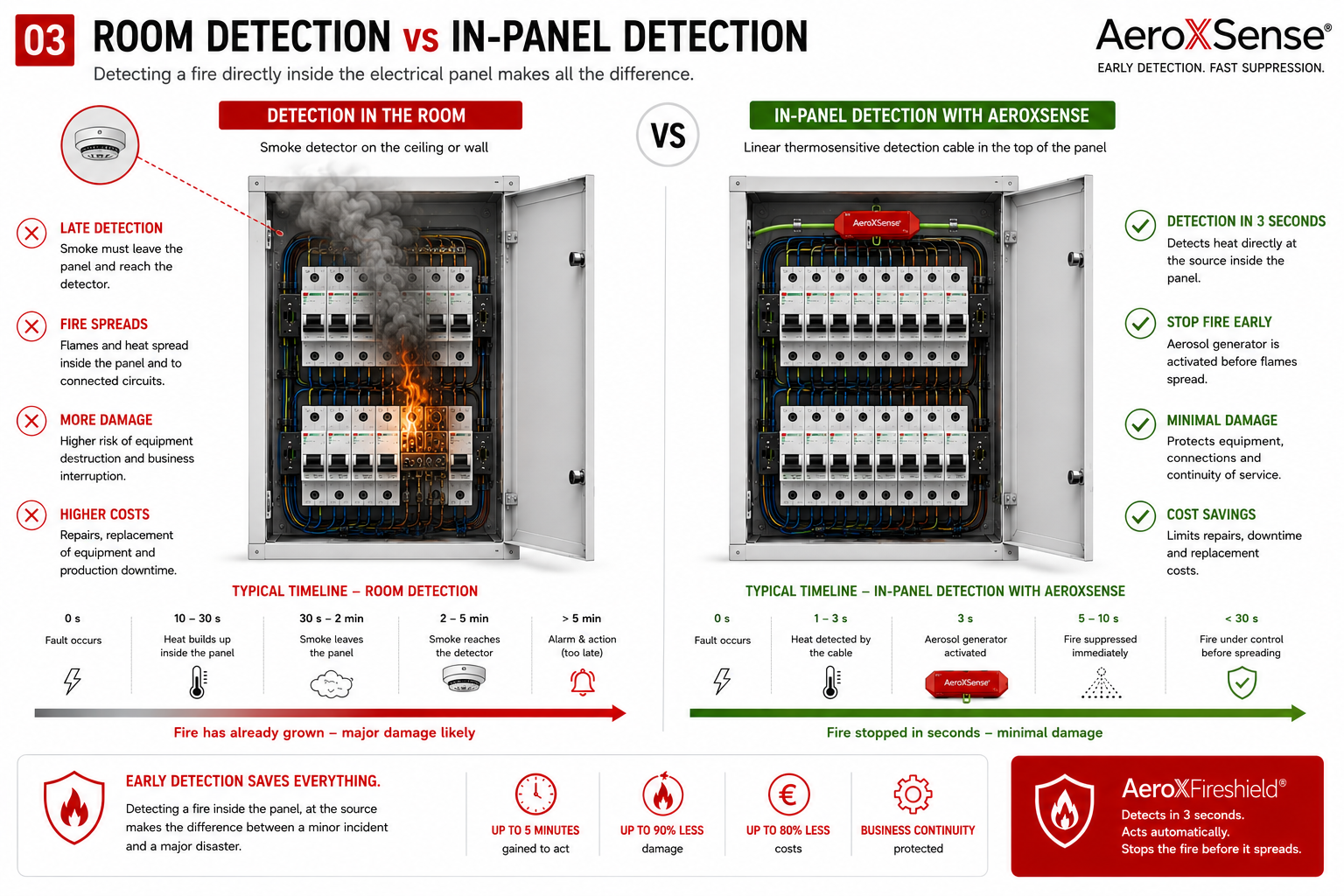
Linear detection at the first hot spot vs global threshold activation: reaction time drives the extent of the damage. Learn more about linear detection →
Comparable detection, but everything else changes
Tube-based systems (FireDETEC, Firetrex, ReflexOFeu…) offer comparable, responsive detection. AeroXFireshield then stands out on every other criterion.
Eco-friendly & clean
Residue-free condensed aerosol, without depleting oxygen.
Light & ultra-compact
No external tank or piping; direct in-cabinet mounting.
Maintenance-free
No heavy periodic inspection for 5 years.
More economical
Controlled purchase cost and TCO.
No specialist labour
Simple install, no dedicated certified technician.
Connected
Status reporting, power cut-off and radio supervision.
Which solution should you choose for your electrical cabinets?
Choosing an automatic device comes down to a trade-off between the volume to protect (in m³), detection speed, equipment criticality, budget and connectivity needs. Here is the summary of the comparison.
AeroXFireshield (AeroXSense) — the most versatile solution for small and medium volumes. Made in France, with linear detection (2-3 s), connected and with no heavy maintenance, it covers up to 8-9 m³ in series across the Residential, Pro and Industry ranges.
FirePro — robust and multi-certified for complex applications or larger volumes, with a higher cost and more specialised installation.
AF-X Fireblocker — proven aerosol for medium volumes; threshold activation and integration that varies by model.
Amulette Feu — compact for small volumes, but dependent on the NOVEC agent, whose discontinuation has been announced.
EXXFIRE — high-end for critical environments (data centres); complex and expensive.
FireDETEC, Firetrex, ReflexOFeu — reliable, but often bulky (external tank/tube) and with heavier maintenance.
TraceFlam — dedicated to professional kitchens, outside the scope of electrical cabinets.
Our recommendations by profile
Boards & small enclosures (< 1 m³)
AeroXFireshield Residential: compact and cost-controlled.
Pro enclosures & cabinets (1 to 5 m³)
AeroXFireshield Pro, linear detection and connectivity.
Industrial cabinets & switchboards (up to 8-9 m³)
AeroXFireshield Industry in series, status reporting and power cut-off.
Alarm reporting (fire panel/BMS) or control
Connected AeroXFireshield or FirePro depending on supervision.
Very large volumes (> 8-9 m³) or ATEX
FirePro or Firetrex, sized for large volumes.
Critical environments (data centre)
EXXFIRE, fine detection and permanent monitoring.
AeroXFireshield resources and solutions
These pages detail the technology, sizing and ranges.
Linear detection
The heat-sensitive cable explained
Sizing
Choosing the right reference
Electrical cabinets
Protecting electrical enclosures
Residential range
Boards and small enclosures
Industry range
Large cabinets and switchboards
Interfaces
Reporting, cut-off and supervision
How to choose
Matching the system to your setup
Protect at source
Why act inside the volume
Automatic fire suppression for electrical cabinets: frequently asked questions
Which extinguishing technology is best for a cabinet?
Why is linear detection an advantage?
What volume can be protected?
Is annual maintenance required?
Can the system connect to a BMS or fire panel?
Is Amulette Feu still a sustainable option?
Not sure which solution fits your cabinets?
Send us your volumes, constraints and supervision needs. We will point you to the most relevant solution and size the protection.
