Fire suppression system for a photovoltaic installation
AeroXFireshield automatically detects and suppresses fire inside electrical volumes associated with photovoltaic installations: AC/DC enclosures, panels, protection cabinets, conversion equipment and compatible technical rooms.
Fire protection for electrical volumes associated with photovoltaic installations.
Where can fires begin?
A photovoltaic installation combines DC circuits, protection devices, connections and conversion equipment. A poor contact, degraded component or arc may cause sustained overheating and ignition.
DC terminals and connections
Loose tightening, oxidation or degradation can create a hot spot.
Connectors and joints
Incompatibility, poor crimping or ageing may increase contact resistance.
Disconnectors and protection devices
An internal fault in a switch, surge protector or protection device may cause arcing or overheating.
Inverters and conversion
Power supplies, capacitors, boards and power components are sensitive technical areas.
AC enclosures and associated panels
Loose connections, overload and insulation faults remain possible on the AC side.
Cabling and routes
Fire may spread through conductors, ducts and passages to other equipment.
Which photovoltaic equipment can be assessed?
Compatibility depends on whether the volume is closed or semi-closed, its ventilation, geometry and access to hazard areas.
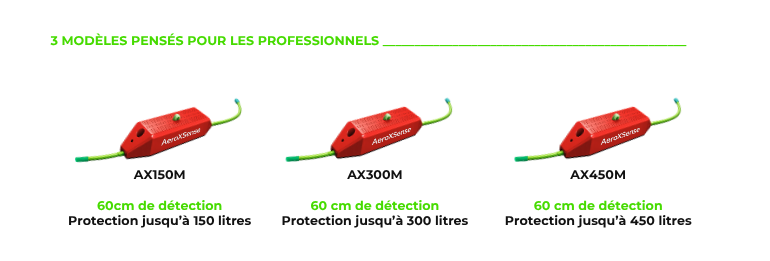
Small associated enclosure or panel
- Compact AC or DC boxes
- Residential connection panels
- Compatible small closed equipment
- Selection by width, volume and layout
Professional enclosure or cabinet
- Protection and distribution cabinets
- Monitoring or communication enclosures
- Compatible inverter enclosures
- Linear detection along terminal areas
Large cabinets and technical rooms
- Conversion or distribution cabinets
- Several compartments or generators
- Groups of cabinets
- Whole-room assessment where required
Why protect the enclosure or cabinet directly?
General building detection may respond only after smoke or heat has escaped from the equipment. Local protection aims to act before that spread.
Protection inside the enclosure
- Detection above electrical hazard areas
- Automatic activation without human presence
- Agent quantity matched to internal volume
- Reduced risk of spread outside the enclosure
Protection of the room
- Treats the whole room volume
- Includes several cabinets and external hazards
- Requires analysis of openings and ventilation
- May complement local equipment protection
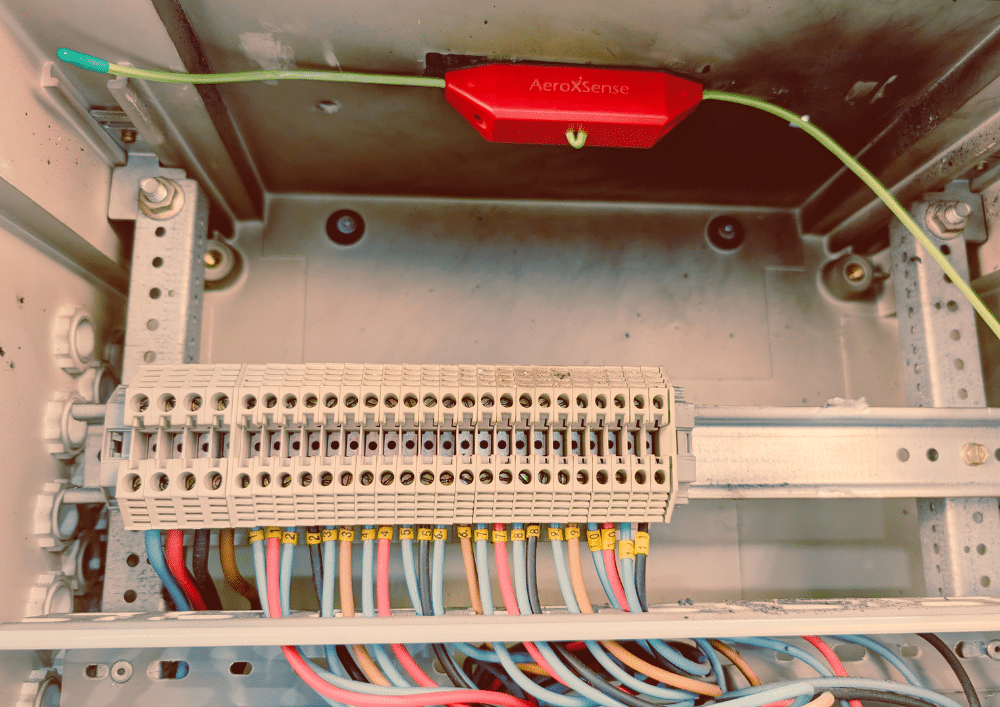
Detect heat and interrupt combustion inside the electrical volume
The system combines thermal detection with a condensed-aerosol generator sized for the enclosure, cabinet or compartment.
Hot-spot detection
Heat-sensitive cable is positioned above targeted connections, protection devices and components.
Automatic activation
When the local thermal threshold is reached, the generator activates without human intervention.
Aerosol distribution
The solid formulation produces active particles throughout the enclosed volume.
Flame interruption
The particles mainly interrupt the chemical chain reaction sustaining combustion.
Volume alone is not enough to choose the correct model
A reliable assessment must check suppression capacity, discharge zone and detection route.
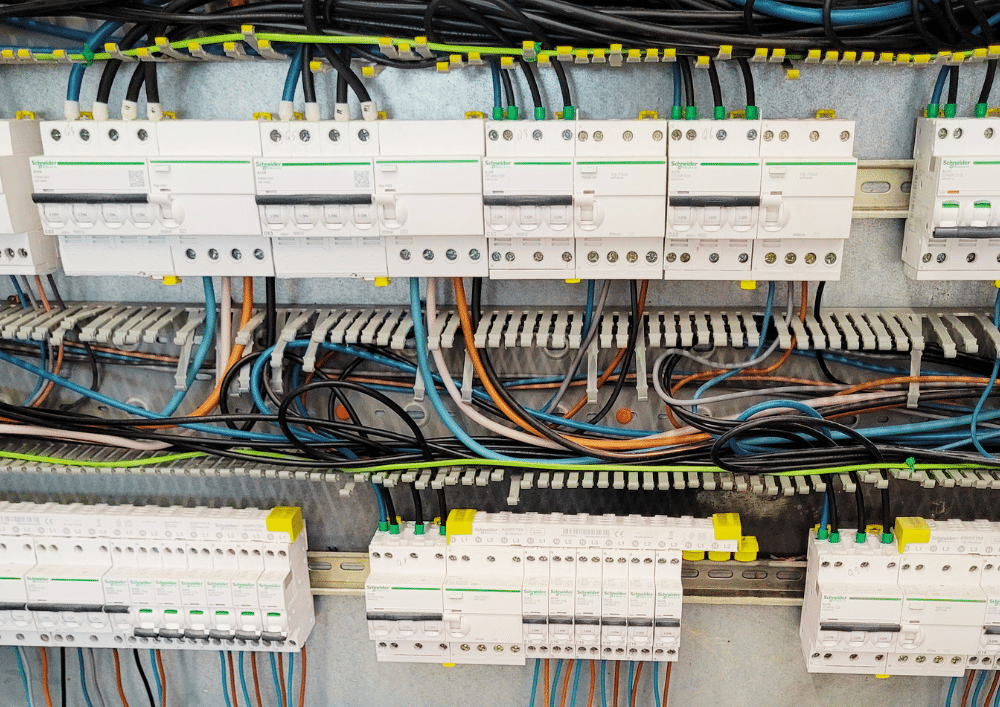
Ventilated inverters and cabinets require a specific assessment
Strong airflow can remove the agent before the required concentration is reached or retained. Compatibility with every inverter must never be assumed.
| Configuration | Guidance | Key consideration |
|---|---|---|
| Closed or lightly ventilated enclosure | Standard assessment by volume, width, height and detection | Check cable entries and permanent openings |
| Cabinet with forced ventilation | Specific assessment | Analyse fan shutdown, delay and potential agent loss |
| Compact ventilated inverter | Compatibility to confirm | Check internal access, manufacturer warranty, airflow and space |
| Several compartments | Assessment by zone | Each compartment may need its own generator and detection |
| Room with several cabinets | Electrical-room architecture | Assess local, whole-room or combined protection |
Integrate protection into photovoltaic-system operation
Depending on the project, interfaces can report activation or control an external device. Aerosol itself does not interrupt current from the modules.
Activation reporting
Send information to an alarm, PLC or supervision system.
Dry contact
Possible interface with BMS, photovoltaic monitoring or third-party equipment.
Shutdown command
Possible control of a contactor, motorised breaker or compatible safety input.
Ventilation stop
Possible safe-state control of fans to reduce agent loss.
Radio and cloud connectivity
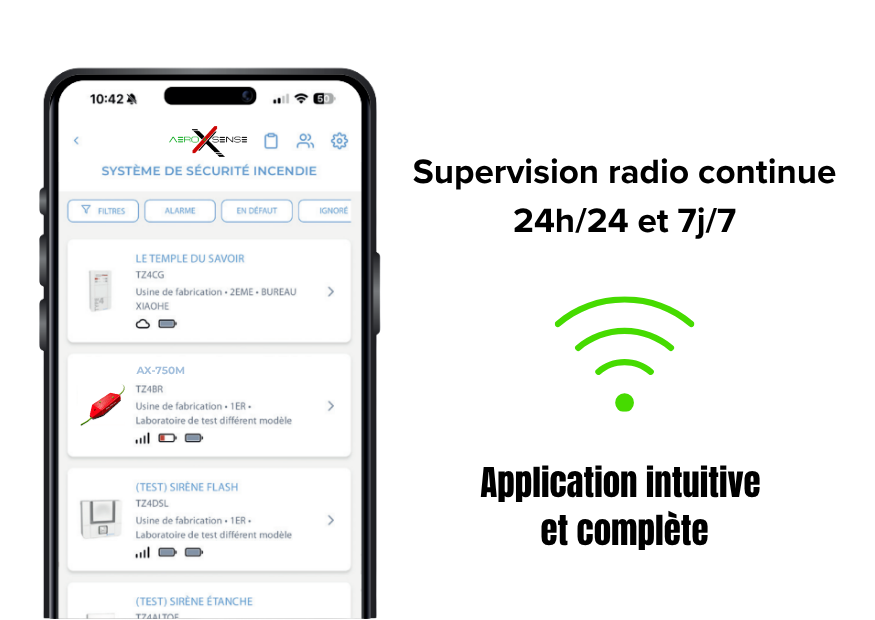
Status reporting and mobile notifications depending on connected versions.
Multi-site management
Monitor enclosures or cabinets across several buildings depending on the selected service.
What local protection must not imply
A credible design distinguishes the actual scope of the system from other risks within the installation.
Which photovoltaic projects are concerned?
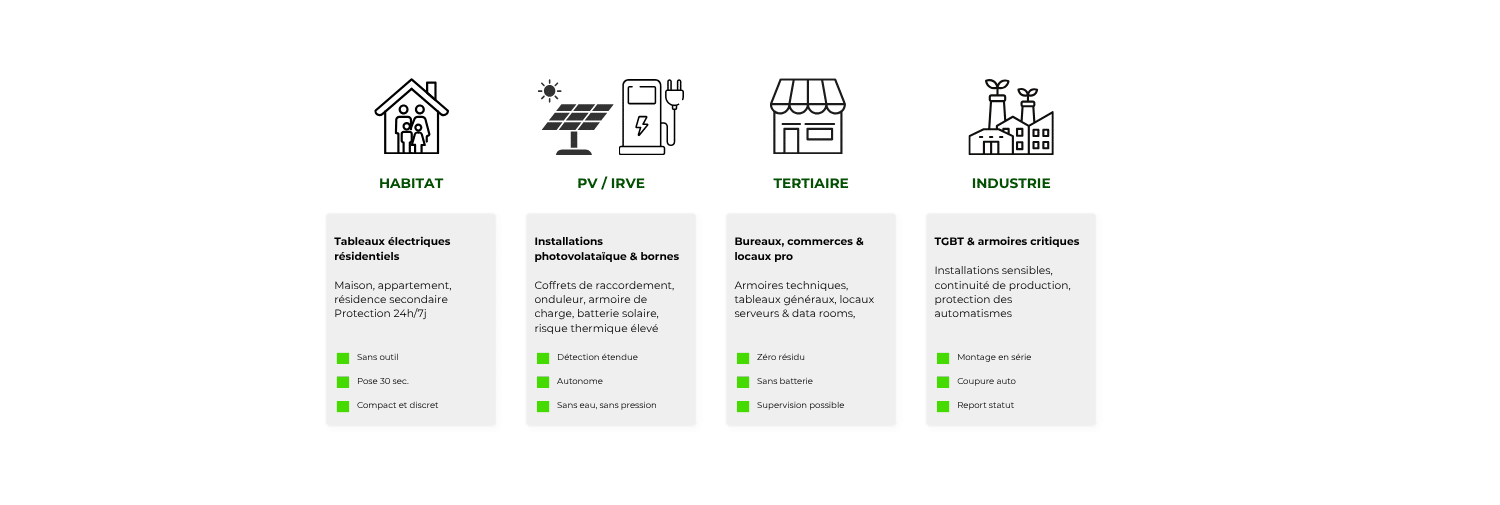
Protection can be assessed for residential, commercial or industrial installations with identified electrical volumes.
Residential self-consumption
Associated panel, small AC/DC enclosure and compatible technical equipment.
Commercial buildings
Connection, monitoring and distribution cabinets in technical areas.
Agricultural buildings
Enclosures and cabinets often remote or exposed to harsh environments.
Solar carports
Protection of cabinets and equipment associated with parking canopies.
Ground-mounted plants
Combiner boxes, conversion cabinets and multi-site installations.
Industrial sites
Integration with existing electrical cabinets and supervision systems.
Public buildings
Protection of technical equipment and status reporting to building management.
Systems with storage
Electrical protection complemented by a dedicated lithium-battery assessment.
Build a coherent fire-protection strategy around the photovoltaic project
Electrical cabinets
Local automatic protection inside professional enclosures and cabinets.
Sizing
Select the model by volume, width, height, ventilation and compartments.
Interfaces and shutdown
Status reporting, dry contact, de-energisation and supervision.
Condensed aerosol
Understand how the extinguishing agent is generated and works.
Electrical rooms
Study whole-room architecture where several systems share a technical room.
Lithium batteries
Separate electrical-enclosure protection from thermal-runaway risk.
Professional ranges
Compare Habitat, Pro and Industry by application.
Instruction manual
Review installation, detection and commissioning rules.
Frequently asked questions about photovoltaic fire protection
Comment protéger une installation photovoltaïque contre l’incendie ?
La prévention associe une installation conforme, des connexions correctement réalisées, une maintenance régulière, une surveillance des échauffements et, lorsque le risque le justifie, une détection et une extinction automatiques dans les coffrets ou armoires.
Peut-on protéger directement les panneaux photovoltaïques en toiture ?
La solution AeroXFireshield présentée ici protège des volumes électriques clos ou semi-clos. Elle ne protège pas directement l’ensemble de la surface des panneaux installés sur une toiture.
Quel système utiliser pour un coffret DC ?
Le choix dépend de la largeur, du volume, des composants, des compartiments, de la ventilation et de la localisation des connexions DC. Une étude est recommandée.
Peut-on protéger un onduleur photovoltaïque ?
Cela dépend de la géométrie, de la ventilation, de l’accès interne, des contraintes du constructeur et de l’espace disponible. La compatibilité ne doit pas être supposée automatiquement.
Le système coupe-t-il le courant des panneaux ?
Non. Le générateur agit sur le feu mais ne coupe pas directement le courant. Une interface peut éventuellement commander un organe externe compatible, à définir dans le projet.
Pourquoi la tension DC peut-elle rester présente ?
Les panneaux peuvent continuer à produire une tension lorsqu’ils sont éclairés. La stratégie de coupure, de sectionnement et de consignation doit donc être conçue séparément.
Peut-on protéger une armoire photovoltaïque ventilée ?
Oui dans certaines configurations, mais la ventilation peut entraîner l’agent. Il faut analyser les ventilateurs, les ouvertures, leur arrêt éventuel et la capacité nécessaire.
Comment dimensionner le système ?
Il faut vérifier le volume, la largeur, la hauteur, les compartiments, la ventilation, la densité des équipements et le parcours du câble thermosensible.
L’aérosol condensé est-il adapté aux équipements électroniques ?
L’objectif est d’interrompre rapidement la combustion et de limiter les dommages. Après toute activation, les équipements doivent être inspectés, nettoyés selon les procédures applicables et remis en service par des professionnels.
Peut-on relier l’activation au monitoring photovoltaïque ?
Selon l’architecture, un contact sec ou une interface peut transmettre l’état à un automate, une GTB/GTC ou un système de supervision compatible.
La protection remplace-t-elle la maintenance ?
Non. Elle complète la maintenance, le contrôle des serrages, la thermographie, le nettoyage et le remplacement des composants dégradés.
Une batterie lithium peut-elle être protégée de la même manière ?
Le risque batterie est spécifique. Les équipements électriques associés peuvent être protégés, mais l’emballement thermique des cellules nécessite une étude et une stratégie dédiées.
Faut-il plusieurs générateurs dans une grande armoire ?
Oui lorsque la largeur, le volume, la hauteur ou les compartiments dépassent la capacité d’une seule unité.
Quelle gamme choisir ?
Les petits coffrets peuvent relever de la gamme Habitat ou Pro. Les armoires professionnelles relèvent généralement de Pro ou Industrie. La sélection finale dépend du dimensionnement.
Quelles informations transmettre pour une étude ?
Dimensions intérieures, photos, schéma de l’installation, ventilation, compartiments, équipements présents, zones DC/AC et besoins de report ou de coupure.
Do you have a photovoltaic enclosure or cabinet to protect?
Send internal dimensions, photographs, the AC/DC diagram, ventilation, compartments and installed equipment. We will determine the protectable scope, model and detection route.