Industrial fire prevention: protect critical equipment before fire spreads
Industrial fire prevention does not rely on a single device. It combines risk assessment, maintenance, early detection, automatic suppression at the source and transmission of information to operating teams.
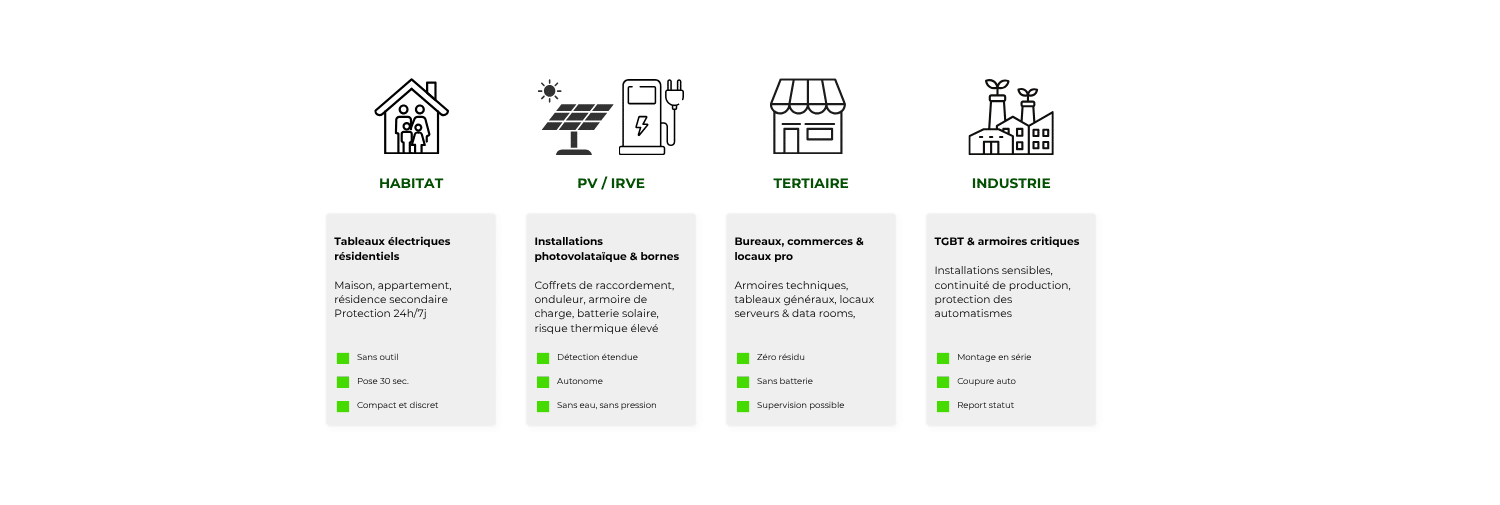
A coherent strategy combines prevention, detection, local suppression and business continuity.
Why do industrial fires often start in electrical equipment?
Industrial installations combine power, automation, dust, vibration and continuous operation. A local fault can stop a production line or spread throughout the facility.
Overheated connection
Poor tightening, oxidation or contact resistance can create a progressive hot spot.
Electrical arc
Insulation failure, overvoltage or a damaged component can initiate an arc.
Drives and power supplies
Power electronics are exposed to significant thermal stress.
PLCs and relays
An internal failure can affect machine or process control.
Ventilation failure
A blocked fan or clogged filter can rapidly increase temperature.
Dust and deposits
Deposits insulate components and may promote fire spread.
Build a coherent industrial fire prevention strategy
The most robust approach combines several complementary layers rather than relying on one barrier.
Maintenance and inspection
- Connection tightening
- Periodic thermography
- Cleaning and ventilation
- Replacement of ageing components
Data and trends
- Temperature history
- Drift detection
- Maintenance alerts
- Analysis of critical environments
Identify the fire start
- Linear detection near risks
- Coverage of several areas
- Autonomous response
- Risk-based cable routing
Limit propagation
- Action inside the protected volume
- Compact condensed aerosol
- No pressurised cylinder
- Multi-generator architecture possible
From risk assessment to event reporting
Each industrial project must define an action sequence compatible with the process and the site’s safety requirements.
Equipment study
Dimensions, compartments, ventilation, components and asset criticality.
Detection layout
The heat-sensitive cable is placed above areas likely to initiate a fire.
Associated actions
Power shutdown, ventilation stop or contactor control when required.
Suppression and reporting
Generator activation followed by event transmission to monitoring systems or teams.
Follow risk areas instead of monitoring a single point
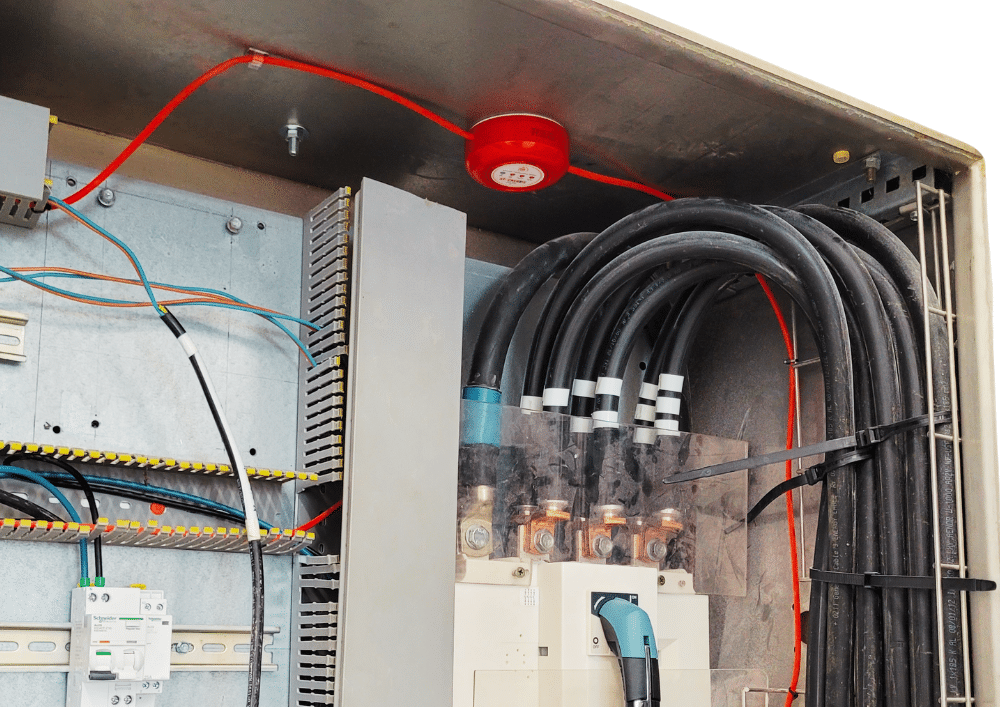
Potential sources in an industrial cabinet are distributed across several rows and compartments. Linear detection can follow terminals, drives, power supplies, contactors and PLCs.
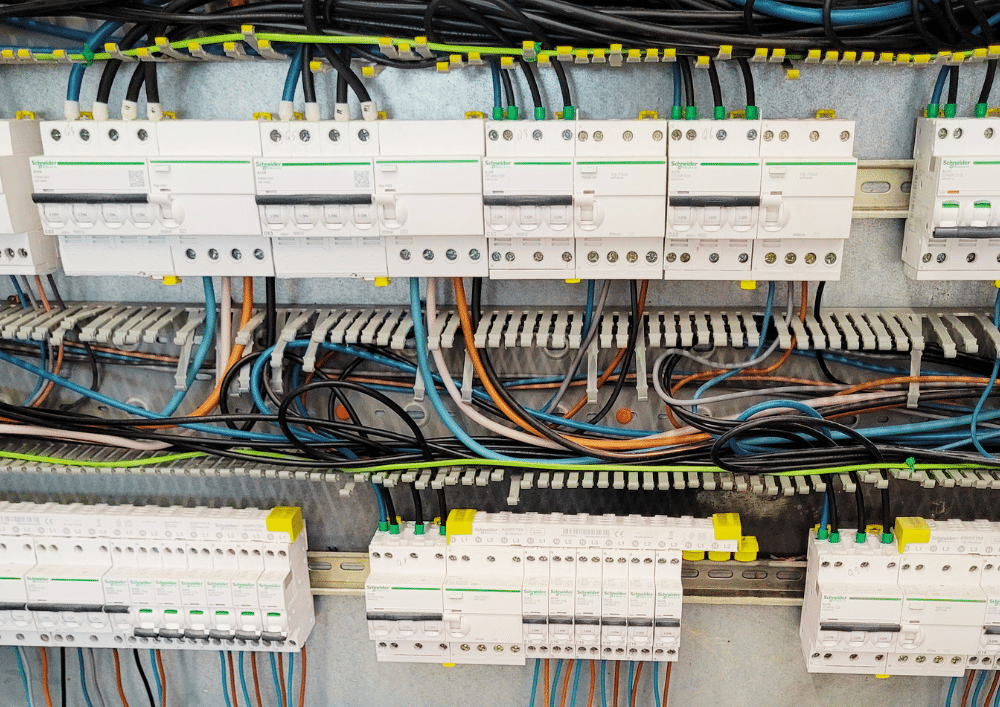
The detection route is defined according to the position of the most sensitive components and connections.
Which equipment can be included?
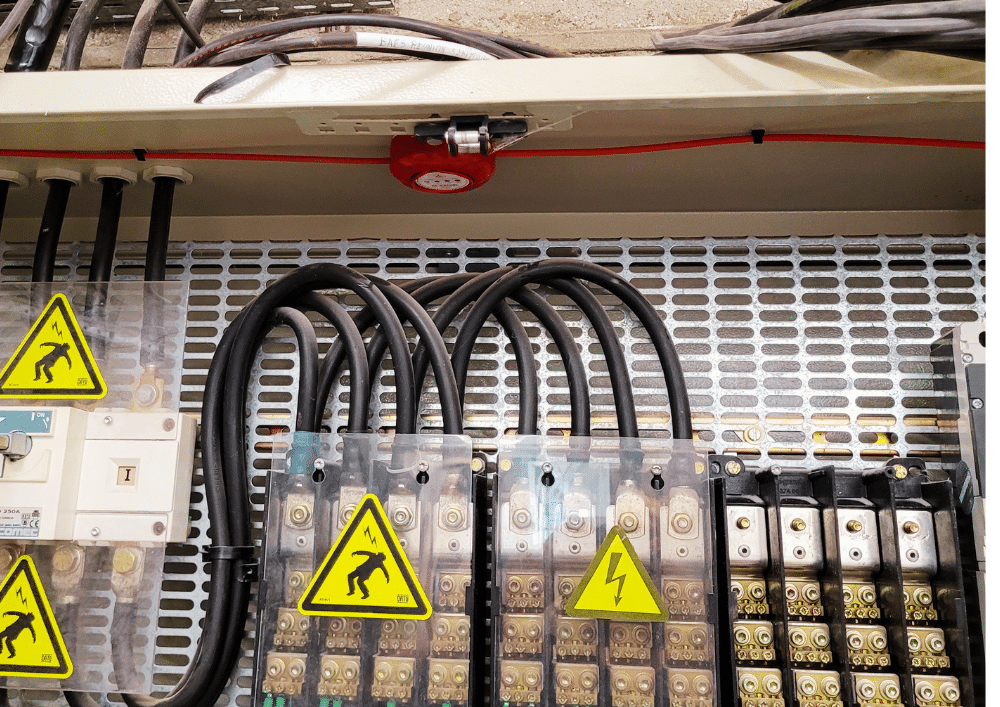
Protection is studied by enclosure, cell or technical volume to act as close as possible to the possible origin of fire.
Electrical cabinets
Distribution, control, power and auxiliary systems.
Main switchboards
Cells, busbars, feeders and compartments.
Industrial automation
PLCs, relays, power supplies and drives.
IT racks
Servers, UPS, PDU and network equipment.
Telecom and remote sites
Outdoor cabinets, shelters and distant installations.
Solar and EV charging
AC/DC boxes, inverters, protections and chargers.
HVAC and ventilation
Motor panels, AHUs, extractors and drives.
Machines and processes
Specific equipment requiring a dedicated study.
Volume alone is not enough to select a system
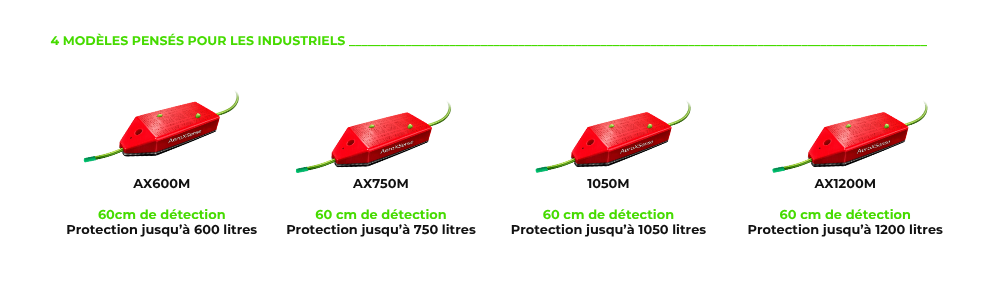
Reliable industrial sizing must consider aerosol distribution capability and the actual geometry of the enclosure.
| Criterion | Why it matters | Impact on the solution |
|---|---|---|
| Useful volume | Determines the minimum quantity of extinguishing agent. | Selection of capacity or number of generators. |
| Width and height | Long distances or obstacles may limit distribution. | Distributed installation or several units. |
| Compartments | Partitions can isolate some areas. | Separate study by cell or compartment. |
| Ventilation | Airflow can remove the aerosol. | Coordinated shutdown of fans or extractors. |
| Risk components | Detection must act close to likely sources. | Cable route adapted to terminals and equipment. |
| Business continuity | Criticality defines reporting and redundancy level. | Interfaces, monitoring and maintenance strategy. |
Integrate fire protection into site operation
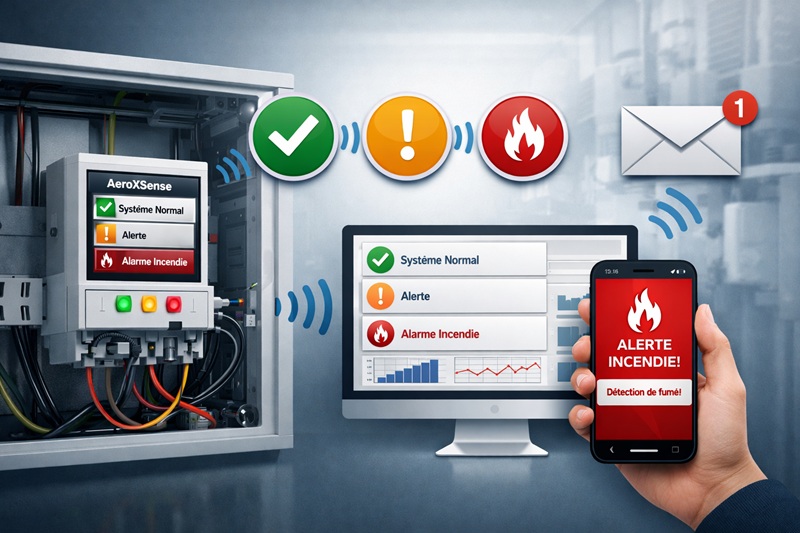
Depending on the project, activation can be linked to electrical shutdown, ventilation stop and reporting to operating systems.
Dry contact
Status transmission to PLC, BMS, SCADA or fire alarm system.
External shutdown
Control of a contactor, breaker or auxiliary equipment.
Ventilation stop
Keeps aerosol inside highly ventilated cabinets.
Connected monitoring
Status, alerts and temperature data depending on the version.
Explore each industrial application
These pages detail the specific constraints of major equipment types and help prepare your project study.
Electrical cabinets
Detection, suppression and sizing for professional cabinets.
Main switchboards
Cell-based architecture and main board protection.
Automation
Protection of PLCs, drives and control equipment.
Electrical rooms
Room-level protection and equipment coordination.
Server racks
Protection of IT and network equipment.
Telecom
Remote cabinets, shelters and unmanned sites.
Solar
AC/DC boxes, inverters and solar installations.
Interfaces
Shutdown, status report and BMS/SCADA integration.
Industrial fire prevention: key answers
What is industrial fire prevention?
Why protect electrical cabinets directly?
Does automatic suppression replace maintenance?
How is generator capacity selected?
Can one generator protect a whole main switchboard?
Must ventilation be stopped?
Can activation be sent to a monitoring system?
What information is required for a study?
Do you want to structure fire prevention for your industrial equipment?
Send dimensions, photos, diagrams, ventilation constraints and monitoring requirements. We will define protected areas, detection route, capacities and required interfaces.
