Why protect the fire at its source instead of waiting for it to spread into the room?
An electrical fire does not begin throughout an entire room. It starts within a few centimetres: a loose connection, a terminal, a contactor, a power supply, a drive or a component exposed to abnormal heat. The closer detection and suppression are to that origin, the greater the opportunity to limit damage, downtime and propagation to the building.
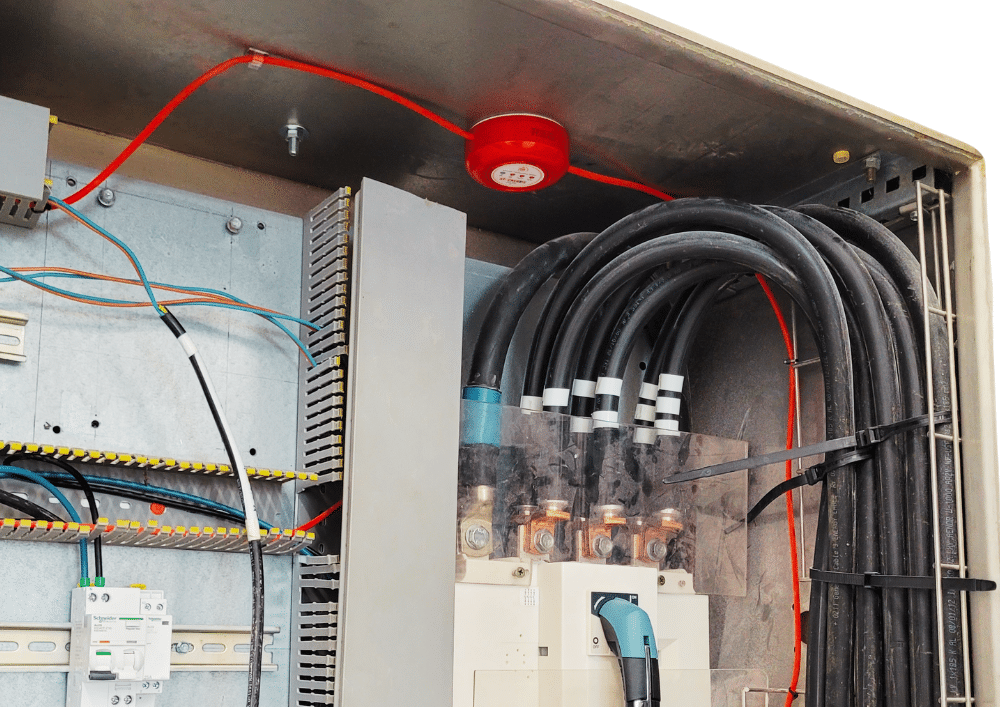
The local approach detects and suppresses the event inside the equipment where it starts, before it reaches the room.
An electrical fire almost always begins in a highly localised area
Before involving the whole cabinet and then the room, the event starts on one component or connection. This initial phase is the best intervention window.
Terminal or connection
Poor tightening, oxidation or contact resistance can create a progressive hotspot.
Contactor or relay
Switching cycles, wear and internal arcing can damage the device.
Drive or power supply
Power electronics combine heat, capacitors and highly stressed components.
Cable or insulation
An insulation fault, mechanical damage or overload can initiate local combustion.
Every second gained acts before the next stage of propagation
Local protection is designed to intervene during the earliest stages, before the event becomes a cabinet fire and then a building fire.
Hotspot
A connection or component reaches an abnormal temperature.
Degradation
Insulation, resins or plastics begin to deteriorate.
Smoke
The first decomposition products appear inside the enclosure.
Flame
Combustion becomes established in a small area.
Cables
Adjacent materials spread the fire to other components.
Cabinet
The fire reaches several rows or compartments.
Room
Smoke and flames leave the enclosure and threaten the building.
Should action begin only once the fire is visible in the room?
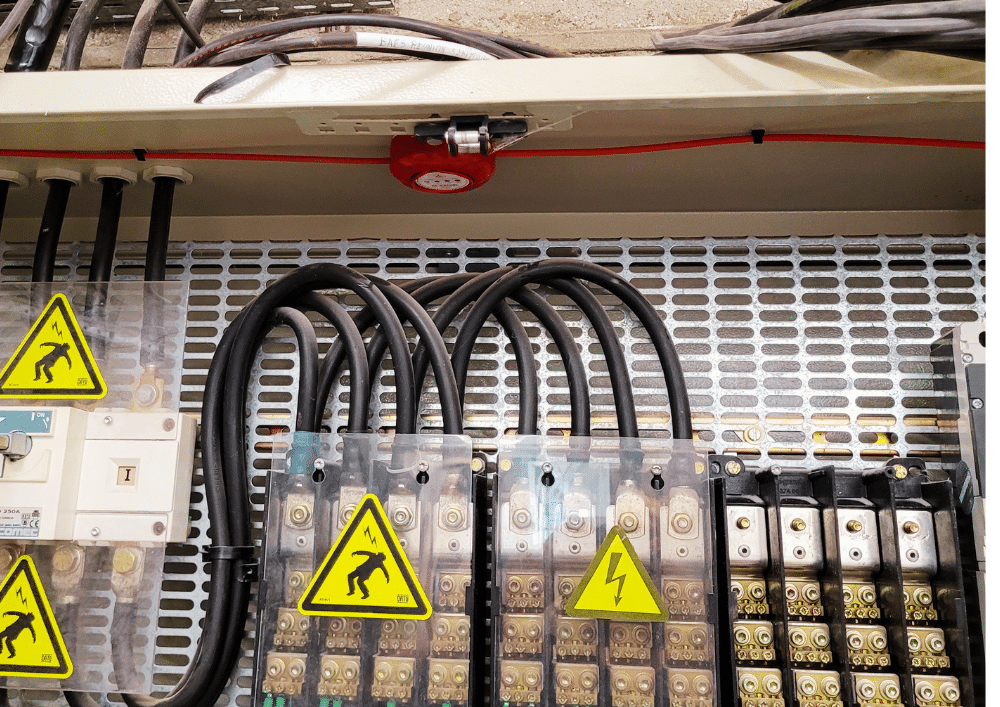
Why ceiling detection may react after the first equipment damage
Inside a closed cabinet, smoke and heat must first accumulate, pass through openings, disperse into the room and then reach the detector. During this time, cables and components inside the enclosure may already be heavily damaged.
The fire is concealed
Cabinet walls delay perception of the event from the room.
Smoke must escape
Room detection depends on smoke movement and the geometry of the building.
The asset is already affected
Even if the room is saved, boards, cables and power components may already be lost.
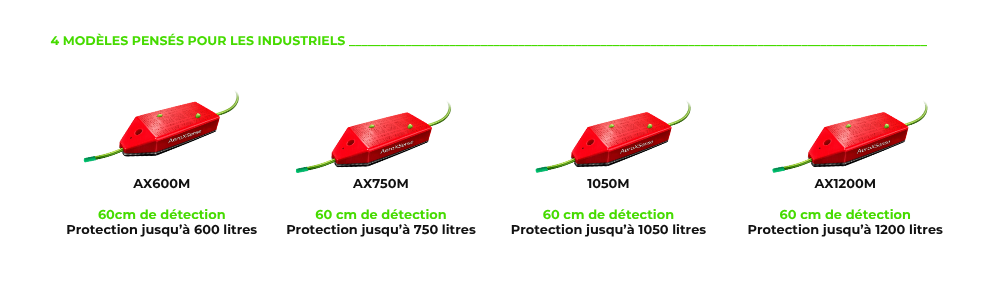
Linear detection follows the areas where a fire can actually begin
A sensor installed at one point cannot simultaneously sit above every terminal, row or compartment. Correctly routed heat-sensitive cable can follow the full cabinet width and several power areas.
Follow terminals
The cable passes above connections and sensitive tightening points.
Cover the width
Risk areas at both ends of the enclosure are not ignored.
Include several rows
Each level containing relevant components can be included in the route.
Adapt to compartments
A separated cell may require its own detection and suppression capacity.
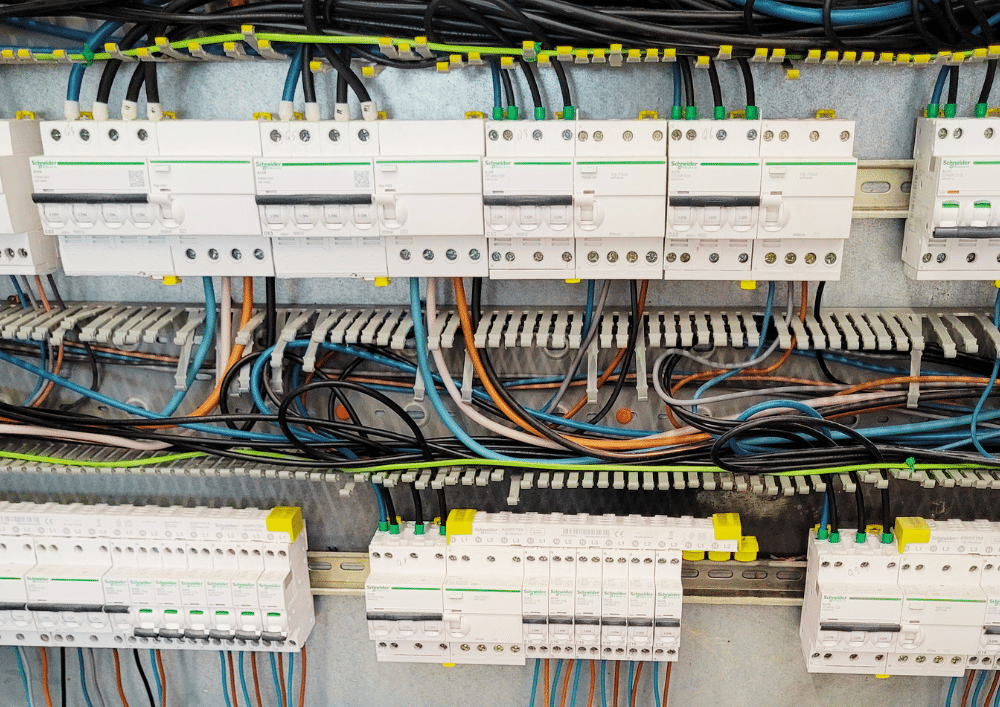
Do not only protect the building: prevent the fire source from becoming a developed fire
The system is installed inside the equipment, detects close to the risk and distributes the extinguishing agent within the small protected volume.
Fire source
A connection or component begins to burn.
Detection
The heat-sensitive cable reacts in the affected area.
Activation
The generator distributes aerosol inside the enclosure.
Containment
The fire is treated before it reaches the room.
Local equipment protection and room protection act at different levels
The aim is not to oppose the two solutions systematically. The comparison explains when each one acts and what it is primarily designed to preserve.
| Criterion | Local protection inside the equipment | Room protection |
|---|---|---|
| Area of action | Inside the cabinet, enclosure or cell. | Across the entire room or technical space. |
| Intervention stage | At the start of the event, before smoke leaves the enclosure. | After smoke or fire is detected in the room. |
| Main objective | Limit equipment damage and prevent propagation. | Protect the room, building and occupants according to the system design. |
| Volume treated | Small enclosed or semi-enclosed volume. | Much larger volume. |
| Agent quantity | Reduced through targeted treatment. | Higher quantity to achieve concentration across the room. |
| Infrastructure | Compact architecture installed inside the enclosure. | Detection, control and distribution infrastructure at room scale. |
| Business continuity | May limit loss to one item of equipment or one cell. | The original asset may already be heavily damaged. |
| Complementarity | Adds a barrier close to the risk. | Remains relevant where risk assessment requires room-level protection. |
Protecting close to the source does not mean selecting a device at random
Local protection must consider agent distribution, volume, width, obstacles, ventilation and compartments. A long or divided cabinet may require several generators.
Useful volume
Determines the minimum extinguishing agent capacity.
Width and height
Distribution must reach every protected area.
Compartments
Partitions may prevent agent movement between cells.
Ventilation
Airflow may require coordinated shutdown.
Local suppression can be integrated into a broader safety sequence
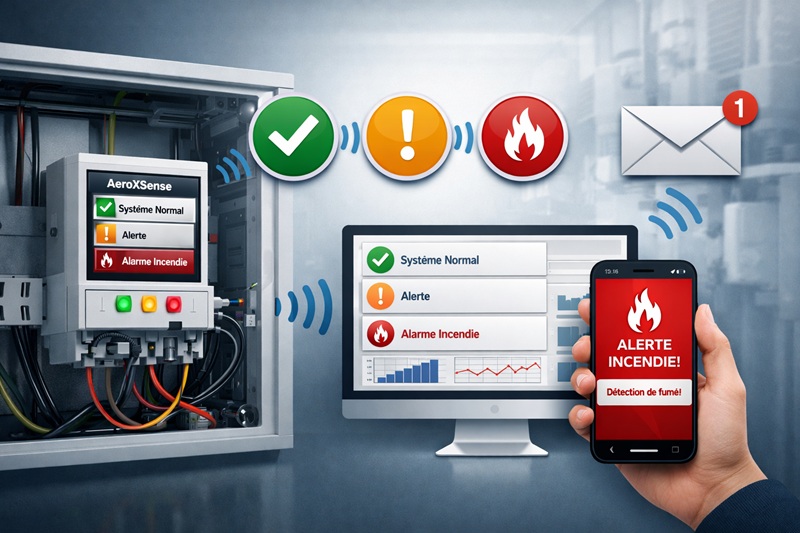
Depending on the project, activation can be linked to electrical isolation, ventilation shutdown or reporting to monitoring systems.
Dry contact
Status transmission to PLC, BMS, SCADA, fire alarm or monitoring.
Electrical shutdown
External control of a contactor or power device.
Ventilation stop
Keeps the extinguishing agent inside highly ventilated cabinets.
Operational alert
Notification to teams for inspection, isolation and replacement.
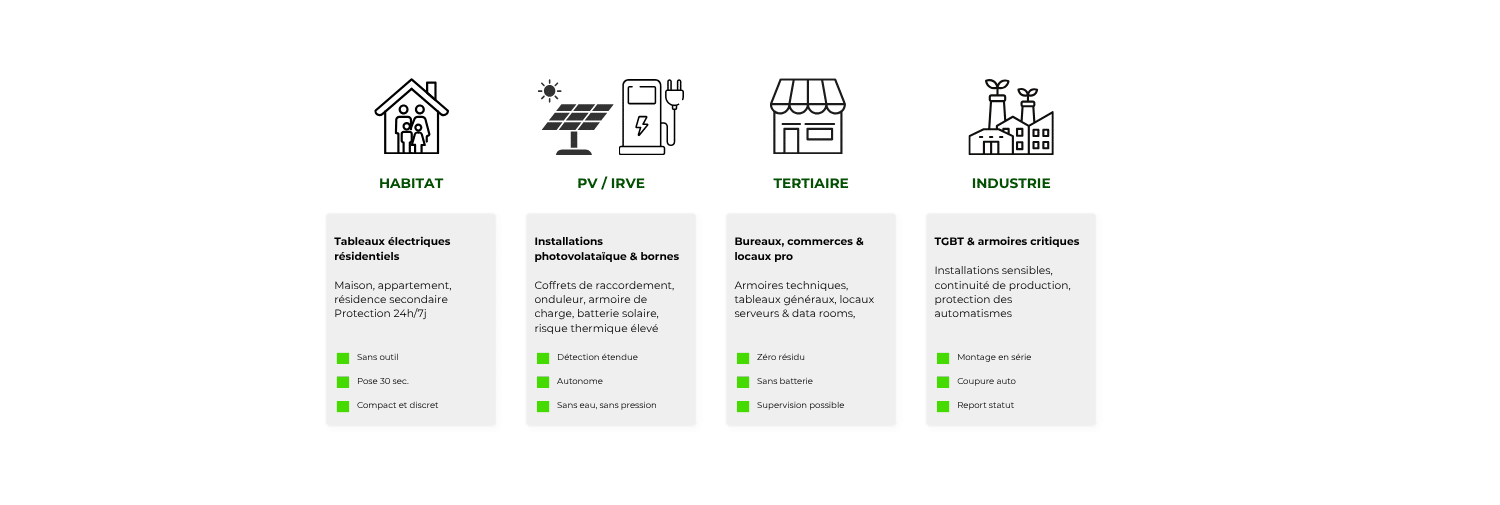
An approach suited to many technical assets
The principle remains the same: identify the enclosure in which fire may begin and act before it spreads into the room.
Electrical panels
Protection of breaker rows, terminals and connections.
Electrical cabinets
Suppression inside professional and industrial enclosures.
Main switchboards
Assessment by cell, compartment and power area.
Industrial automation
Protection of PLCs, relays, power supplies and drives.
Photovoltaic inverters
Action around AC/DC terminals and power electronics.
IT racks
Protection of power supplies, PDU, UPS and network equipment.
Telecom cabinets
Autonomous protection for remote and unmanned sites.
HVAC and ventilation
Protection of motor panels, drives and ventilation systems.
Pool electrical boxes
Protection of pumps, contactors and technical controls.
Photovoltaic installations
Protection of electrical boxes, inverters and conversion equipment.
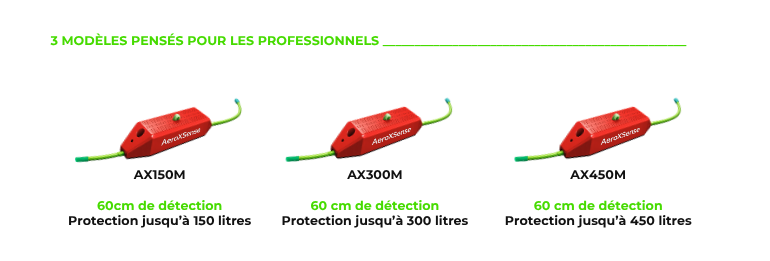
Professional ranges
Pro and Industry models for different volumes and architectures.
Industrial prevention
Integrate local protection into a complete risk-control strategy.
Protecting the fire at its source: key answers
Why protect the fire at its source?
What is the difference between protecting a cabinet and protecting a room?
Does local protection replace the building fire strategy?
Why can local detection react faster?
Which types of equipment can be protected directly?
How is local protection sized?
Why use linear heat detection?
In which sectors is this approach relevant?
Do you want to act as close as possible to the fire source?
Send dimensions, photos, drawings, compartments, ventilation constraints and reporting needs. We will identify the protection zones, detection route and suitable capacity.