Why install a fire suppression system at the top of an electrical cabinet?
The position of the suppression generator directly affects agent distribution, risk-area coverage, detection integration and maintenance access. In most electrical cabinets, a high installation is the most consistent solution, provided the actual geometry, compartments, ventilation and sizing recommendations are taken into account.
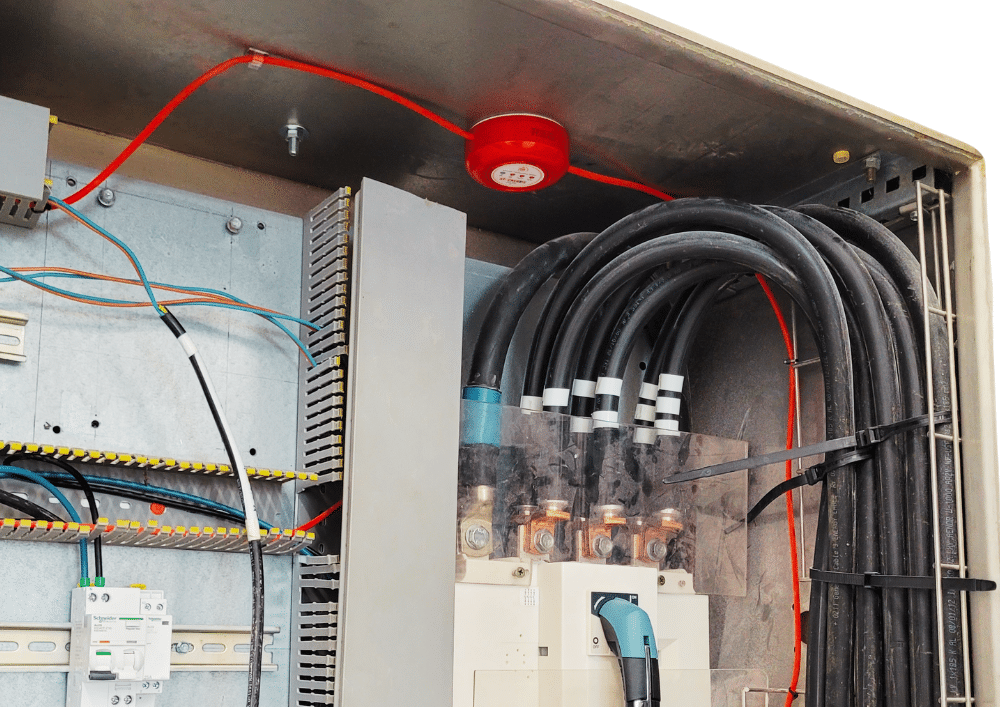
A high position places the system close to upper risk areas and supports coherent distribution inside the enclosure.
Hot gases and smoke naturally tend to rise
During a fire start, hot combustion products rise inside the enclosure. This behaviour is considered when designing local fire protection.
Accumulation at the top
Heat and smoke generally collect above the fire source.
System proximity
The generator is installed in an area consistent with this behaviour.
Early action
Detection above the risk areas can react very early.
A high position supports more uniform distribution through the volume
Installed above the equipment, the generator can distribute the extinguishing agent downward and around the components, provided obstacles and partitions have been correctly assessed.
Downward distribution
The agent moves from the upper area toward lower zones.
Overall coverage
Positioning can support more uniform distribution.
Fewer direct obstacles
The top of the cabinet is often less crowded than the equipment rows.
Distributed architecture
Several generators can be aligned across large widths.
A high position makes detection cable routing easier
The heat-sensitive cable can be routed above terminals, protection devices, contactors, drives and other risk areas while remaining connected to the generator.
Terminals
The cable follows connection and tightening areas.
Protection devices
It passes above breakers and isolators.
Power equipment
It covers contactors, drives and power supplies.
Full width
The route reaches areas at both ends of the cabinet.
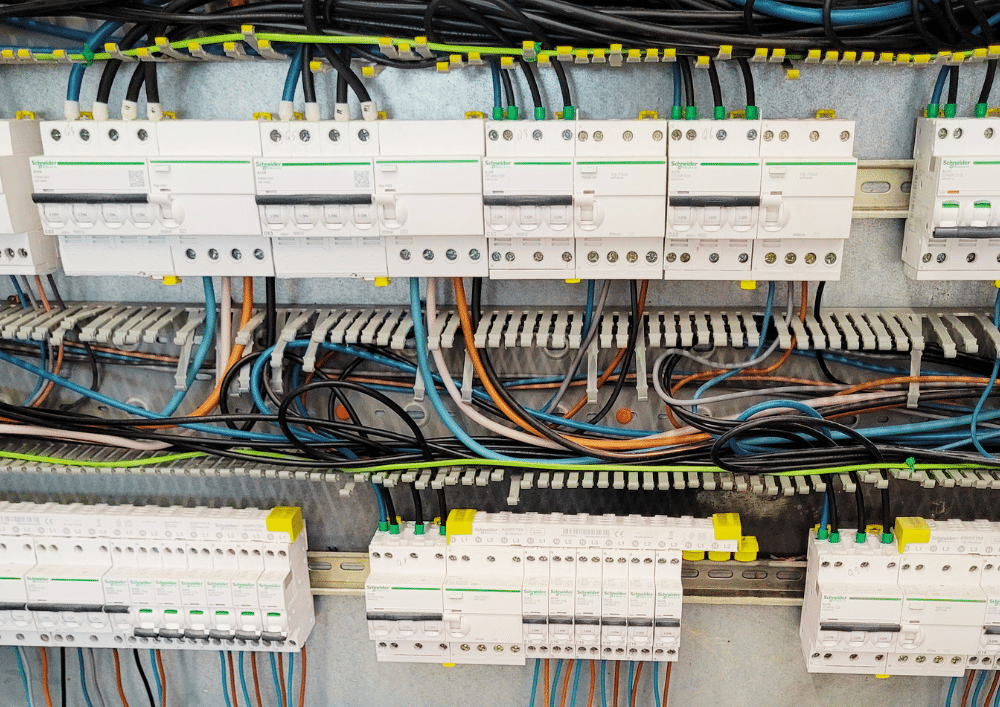
A 40 cm cabinet is not protected in the same way as a 160 cm cabinet
Width directly affects the number of generators, their spacing and the detection route. One installation may be enough for a small enclosure, while a wide cabinet may require several units.
Small enclosure
One unit may sometimes cover the whole volume.
Medium cabinet
Positioning must cover both ends.
Large width
Range and obstacles become decisive.
Very wide cabinet
A multi-generator architecture is often more consistent.
A metal partition may require several generators
A high position alone does not guarantee distribution between several cells. Each compartment should be treated as a potentially independent volume.
Single cell
One high-position installation may sometimes be sufficient.
Several cells
Each volume requires its own assessment.
Several generators
Units are distributed at the top of each cell.
Several cables
Each compartment needs suitable detection.
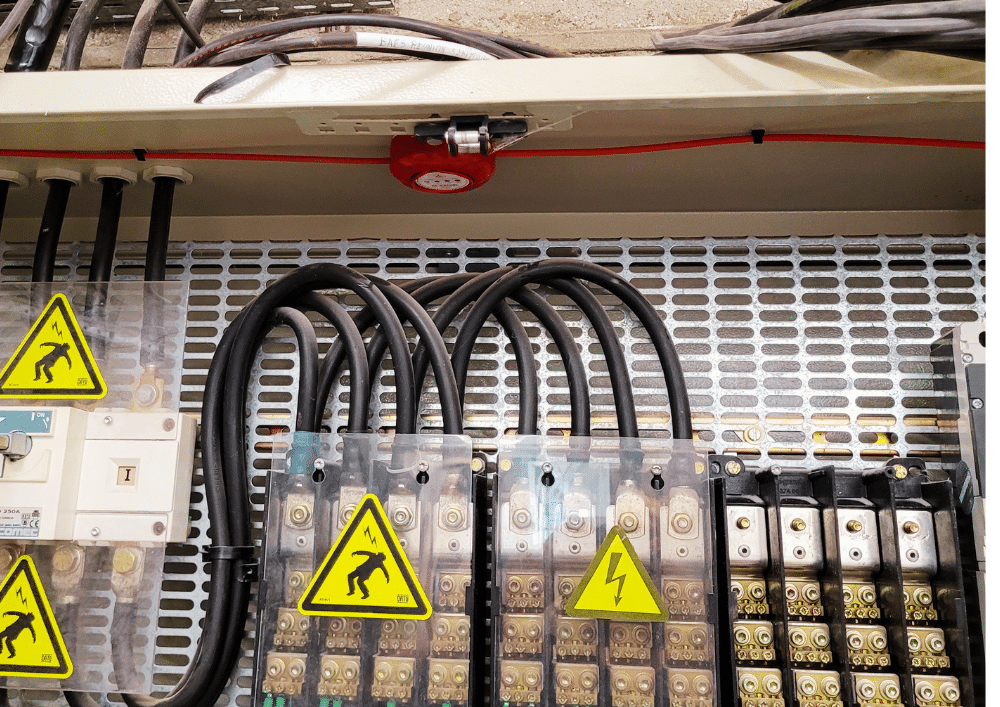
Ventilation can completely change the installation strategy
Forced ventilation or extraction may remove the extinguishing agent and change its distribution. High positioning must therefore be assessed together with airflow.
Natural ventilation
Openings and grilles must be included in the study.
Forced ventilation
Airflow may divert the extinguishing agent.
Permanent extraction
Agent holding time may be greatly reduced.
Coordinated shutdown
An interface can stop fans when activation occurs.
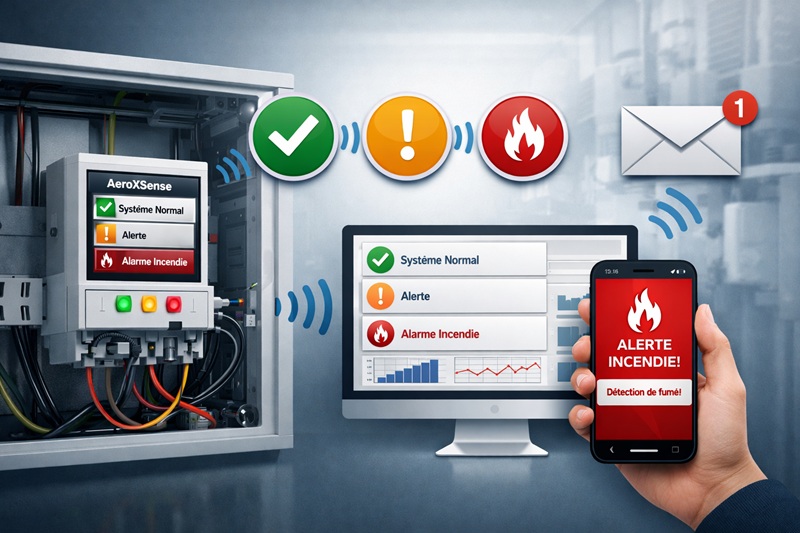
A high position can also improve integration and maintenance access
A well-designed installation should protect the cabinet without obstructing access to breakers, terminals, drives or PLCs.
Access to equipment
The generator must not cover electrical components.
Simple replacement
The device must remain accessible after activation.
Future maintenance
Work inside the cabinet must remain possible.
Durable mounting
The installation must remain stable over time.
Criteria that influence generator positioning
| Criterion | Influence on position | Practical consequence |
|---|---|---|
| Volume | Determines the required capacity. | Selection of model and number of units. |
| Width | Strongly affects coverage. | Generator spacing and distribution. |
| Height | Changes distribution distances. | Validation of position and range. |
| Compartments | May block the agent. | One generator may be needed per cell. |
| Ventilation | Changes airflow. | Possible need for coordinated shutdown. |
| Risk areas | Define the detection route. | Cable position and generator proximity. |
| Obstacles | May restrict distribution. | Architecture adjustment. |
| Maintenance | Requires continued accessibility. | Position compatible with future work. |
| Interfaces | Add shutdown or reporting functions. | Coordination with BMS, SCADA or automation. |
Technical pages to consult
Sizing
Select capacity and number of generators.
Linear detection
Define the heat-sensitive cable route.
Interfaces
Ventilation shutdown, electrical isolation and monitoring.
Electrical cabinets
Understand the complete protection architecture.
Main switchboards
Protect wide cells and switchboards.
IT racks
Adapt installation to ventilated equipment.
Selection guide
Choose a suitable architecture.
Mistakes to avoid
Avoid sizing and installation faults.
High-position installation: key answers
Why install the fire suppression generator at the top of the cabinet?
Can a generator be installed at the bottom?
Where should the heat-sensitive detection cable be routed?
Do compartments change the generator position?
Does ventilation affect the installation?
Can this installation principle be used in a main switchboard?
Does the same principle apply to IT racks?
Who should size the system and approve its position?
Do you need to validate your system position?
Send dimensions, photos, compartments, risk areas, obstacles and ventilation information. We will define the installation suited to your cabinet.