Fire suppression system for industrial control cabinets
AeroXFireshield automatically detects and suppresses fire inside automation, control and machine cabinets. Protection acts directly around power supplies, PLCs, variable-speed drives, contactors, relays and other critical components.
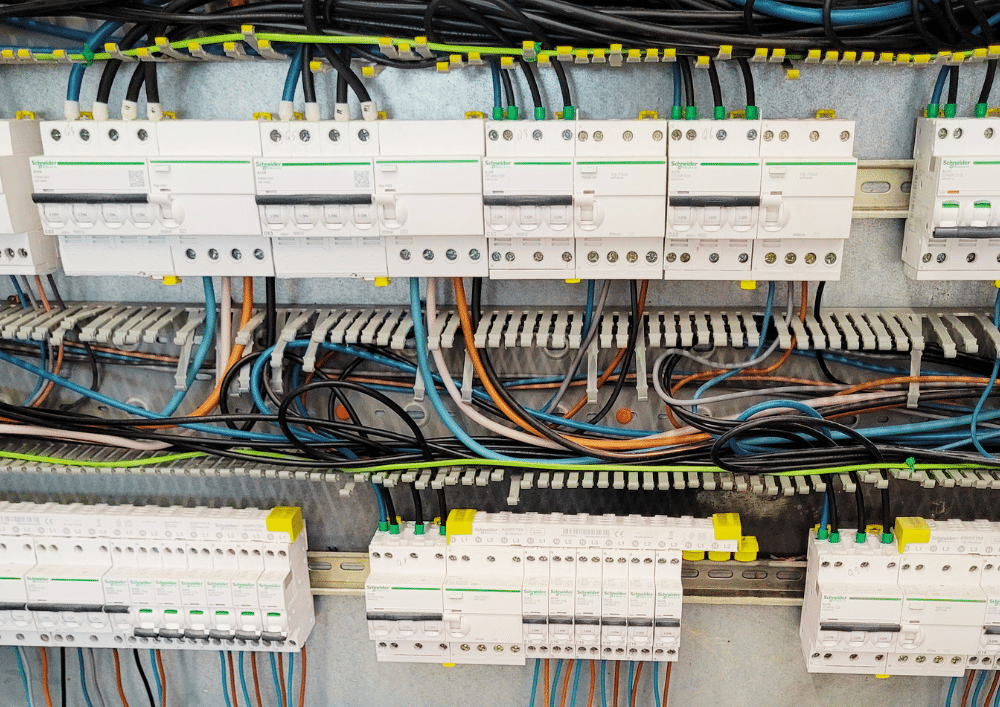
Local fire protection for an industrial control cabinet using linear thermal detection.
A small cabinet can stop an entire production line
A control cabinet may contain less energy than a main switchboard, yet it concentrates the functions required to operate the process.
Production stoppage
Loss of one PLC or drive can stop a machine or complete line.
Diagnostic time
Fire destroys component references, wiring and labels needed for recovery.
Specific spare parts
Some PLCs, cards and drives have long replacement lead times.
Programme loss
Backups, parameters and process recipes may complicate reconstruction.
Indirect damage
Smoke, heat and soot can contaminate nearby components.
Operating cost
Downtime cost often far exceeds the price of protection.
Which components can cause a fire?
Control cabinets combine electronics, power, switching and dense wiring. Several component groups can produce overheating or faults.
24 V power supplies
A degraded or overloaded supply may overheat and damage nearby equipment.
Variable-speed drives
Capacitors, IGBTs, boards and braking resistors are highly stressed.
PLCs and I/O modules
Electronics are sensitive to surges, supply faults and contamination.
Contactors and relays
Repeated cycles and wear may degrade contacts.
Terminals and connections
Loose connections can create persistent hot spots.
Converters and transformers
Voltage-adaptation equipment may overheat.
Ventilation and filters
Blocked filters or failed fans raise internal temperature.
Dense wiring
Cable bundles may hide hot spots and support fire spread.
Why protect the control cabinet directly?
General workshop detection may react only after smoke has escaped. Local protection aims to act before fire spreads to the machine or building.
Protection inside the cabinet
- Detection above sensitive components
- Automatic activation without human presence
- Agent quantity matched to internal volume
- Reduced risk of spread outside the enclosure
Protection of the workshop or room
- Treats the whole room volume
- Includes hazards outside the cabinet
- Requires analysis of openings and ventilation
- May complement local protection
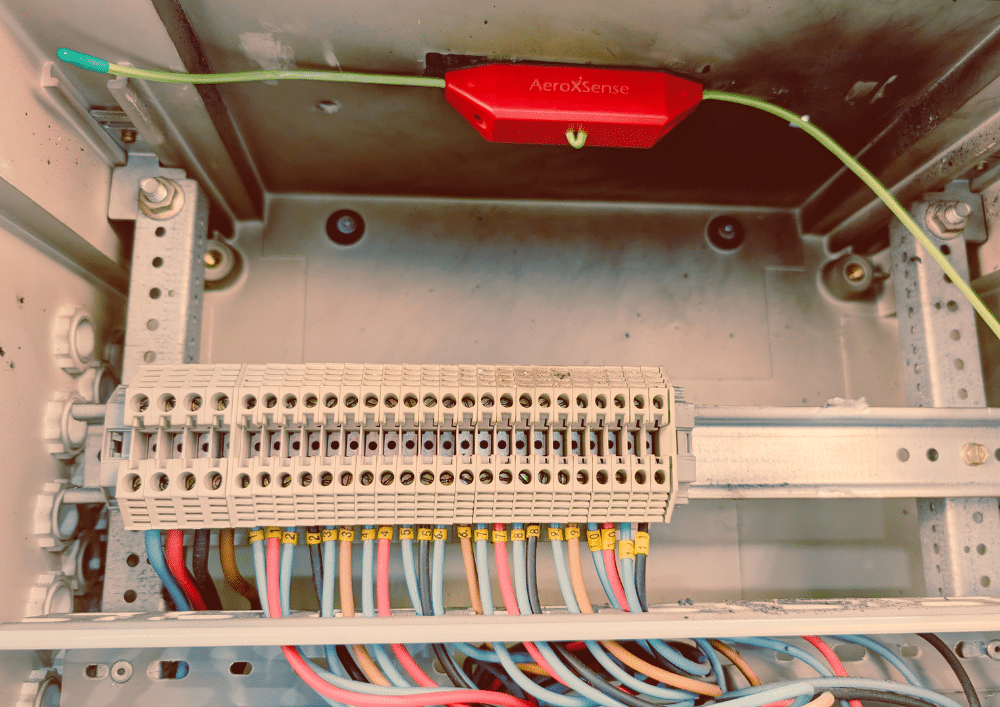
Detect heat and interrupt combustion inside the cabinet
AeroXFireshield combines linear thermal detection with a condensed-aerosol generator sized for the enclosure.
Hot-spot detection
Heat-sensitive cable is positioned above power supplies, drives, contactors and connections.
Automatic activation
When the local threshold is reached, the generator activates.
Aerosol distribution
The solid formulation produces active particles throughout the enclosed volume.
Flame interruption
The particles mainly interrupt the chemical chain reaction sustaining combustion.
Select the model from the actual cabinet geometry
Volume alone is not enough. Width, height, compartments, ventilation and component layout must also be checked.
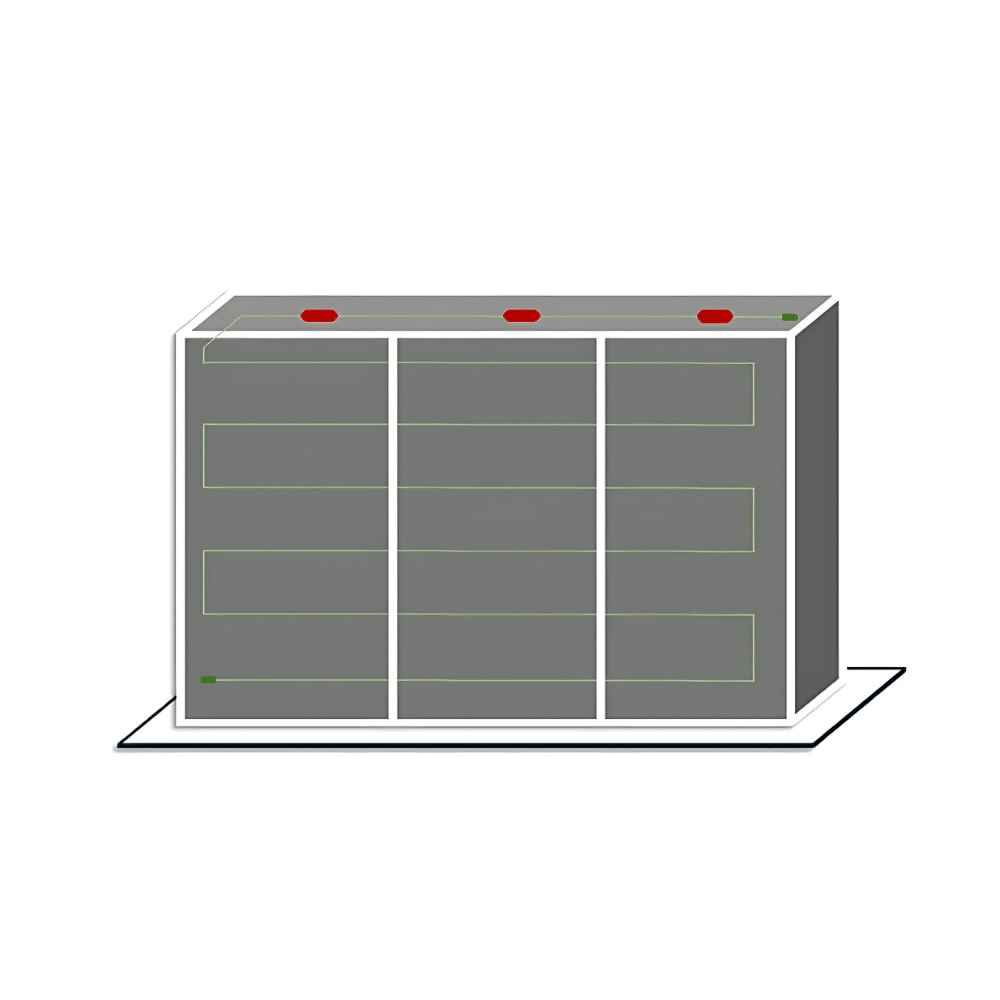
How should detection be routed in a control cabinet?
The cable must follow areas where heat is likely to rise and avoid dead zones.
Connect protection to the PLC, supervision or machine stop
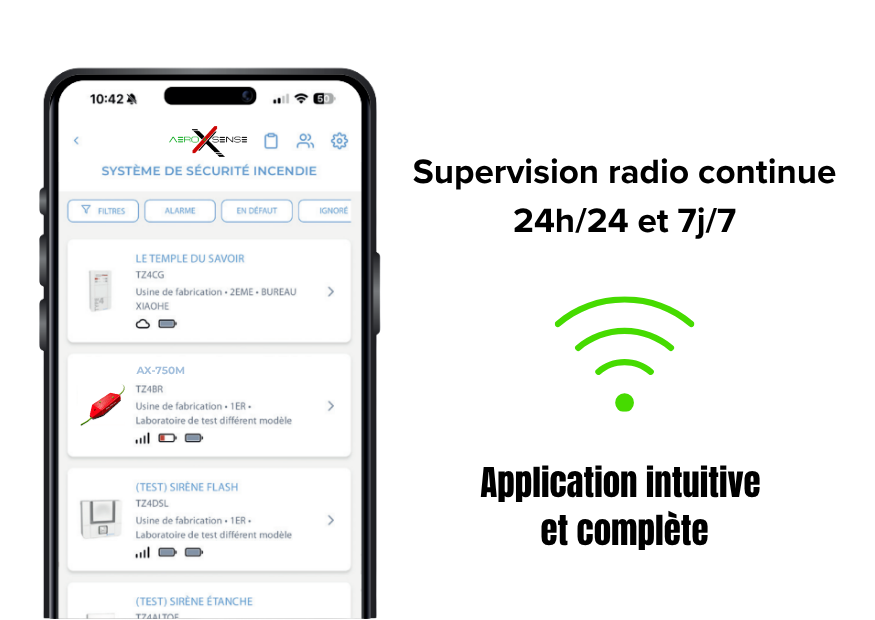
Depending on the project, AeroXSense interfaces can report status or control an external device. Final logic is defined with the integrator or machine builder.
Activation reporting
Send information to a PLC, alarm or supervision system.
Dry contact
Simple interface with PLC, BMS or technical control panel.
Machine stop
Possible command to a safety input or compatible external relay.
Power shutdown
Control of a contactor or motorised breaker designed for the circuit.
Ventilation stop
Possible command to reduce agent loss.
Radio and cloud
Status reporting and notifications depending on connected versions.
Which approach for each cabinet type?
This table provides pre-selection guidance. Final validation depends on dimensions, ventilation and component distribution.
| Configuration | Likely approach | Key consideration |
|---|---|---|
| Small non-ventilated PLC cabinet | AX-150M or Pro range depending on volume | Check width, height and density |
| Cabinet with drives | Pro or Industry | Analyse ventilation and hot spots |
| Compartmented machine cabinet | Several zones or generators | Assess each compartment separately |
| Robot control cabinet | Pro with PLC reporting | Plan machine stop and external shutdown |
| Ventilated process cabinet | Specific assessment | Fan shutdown and suitable margin |
| Several cabinets on one line | Local or room protection | Compare architectures |
Mistakes to avoid
Protection is effective only when correctly sized, installed and integrated with machine operation.
Which industries use critical control cabinets?
Local protection is especially relevant where one cabinet can stop a line, machine or process.
Food processing
Processing, cooking, packaging and refrigeration lines.
Automotive
Robots, conveyors, presses and assembly lines.
Pharmaceutical
Process, filling, packaging and utilities.
Chemical
Process, dosing and technical systems.
Water treatment
Pumping, filtration and station automation.
Paper industry
Machines, drives and process control.
Logistics
Conveyors, sorters, automated storage and refrigeration.
Robotics
Robot cells, cobots and special machines.
Packaging
Baggers, thermoformers, labellers and lines.
Metalworking
Machine tools, furnaces, presses and treatment systems.
Energy
Production, conversion and distribution automation.
OEM and special machines
Factory integration into equipment supplied to customers.
Build a coherent strategy around the control cabinet
Electrical cabinets
Explore local protection for professional enclosures.
Sizing
Select the model by volume, width, height and compartments.
Interfaces and shutdown
PLC reporting, dry contact, machine stop and supervision.
Condensed aerosol
Understand how the extinguishing agent is generated and works.
Main switchboards
Compare with compartmented power-switchboard protection.
Electrical rooms
Assess whole-room protection for several cabinets.
Professional ranges
Compare Pro and Industry models.
Instruction manual
Review installation, detection and commissioning rules.
Frequently asked questions about control-cabinet fire protection
Comment protéger une armoire d’automatisme contre l’incendie ?
La protection combine une installation électrique conforme, une maintenance régulière, une détection thermique positionnée au-dessus des zones sensibles et un générateur dimensionné pour le volume de l’armoire.
Quels composants présentent le plus de risques ?
Les alimentations, variateurs, contacteurs, transformateurs, résistances, borniers et connexions de puissance sont des zones fréquemment surveillées.
Peut-on protéger une armoire avec des automates Siemens ou Schneider ?
La marque de l’automate n’est pas le critère principal. Le volume, la ventilation, la géométrie et l’implantation des composants déterminent la compatibilité.
Le système risque-t-il d’endommager l’automate ?
L’objectif est de limiter les dommages liés au feu. Après toute activation, l’armoire doit être inspectée, nettoyée et remise en service par des professionnels.
Comment dimensionner une armoire avec plusieurs variateurs ?
Il faut mesurer l’armoire, analyser la ventilation, les compartiments, les zones de puissance et vérifier si une ou plusieurs unités sont nécessaires.
Peut-on installer le système dans une armoire existante ?
Oui si un emplacement conforme est disponible et si la détection peut suivre les zones à risque sans obstacle.
Peut-on arrêter automatiquement la machine ?
Une interface peut commander une entrée de sécurité, un relais ou un organe externe, mais cette fonction doit être définie et validée dans l’architecture machine.
Peut-on envoyer l’activation vers l’automate ?
Oui, généralement par contact sec ou interface compatible.
Peut-on protéger une armoire ventilée ?
Oui dans certaines configurations, mais la ventilation peut évacuer l’agent. Son arrêt éventuel et la capacité nécessaire doivent être étudiés.
Faut-il un générateur par compartiment ?
Souvent lorsque les cloisons limitent la circulation de l’aérosol. Chaque compartiment doit être étudié comme une zone potentiellement indépendante.
Un câble de détection plus long permet-il d’utiliser un modèle plus petit ?
Non. Le câble étend uniquement la détection. Il n’augmente ni la quantité d’agent ni la portée du générateur.
Quelle différence entre protéger l’armoire et protéger l’atelier ?
La protection de l’armoire agit au plus près du départ de feu. La protection de l’atelier traite le volume global et les risques extérieurs.
Quelle maintenance faut-il prévoir ?
Les contrôles doivent suivre le manuel : état du produit, fixation, câble de détection, environnement et date de remplacement.
Que faire après une activation ?
Mettre la machine en sécurité, identifier la cause, inspecter et nettoyer l’armoire, remplacer les éléments activés et valider la remise en service.
Quelles informations transmettre pour une étude ?
Dimensions intérieures, photos, ventilation, plans d’implantation, composants présents, compartiments et besoins de report ou d’arrêt.
Do you have a control cabinet to protect?
Send dimensions, photographs, layout drawings, ventilation details, installed components and reporting or machine-stop requirements. We will define the model, detection route and suitable interfaces.
