How to choose a fire suppression system that is genuinely suited to your installation
Not all electrical cabinets present the same constraints. Volume, width, compartmentation, ventilation, installation criticality, business continuity and the detection strategy must be assessed before selecting a solution. The right choice is not simply a matter of determining the amount of extinguishing agent: you must decide when to act, where to detect and what you actually want to preserve.
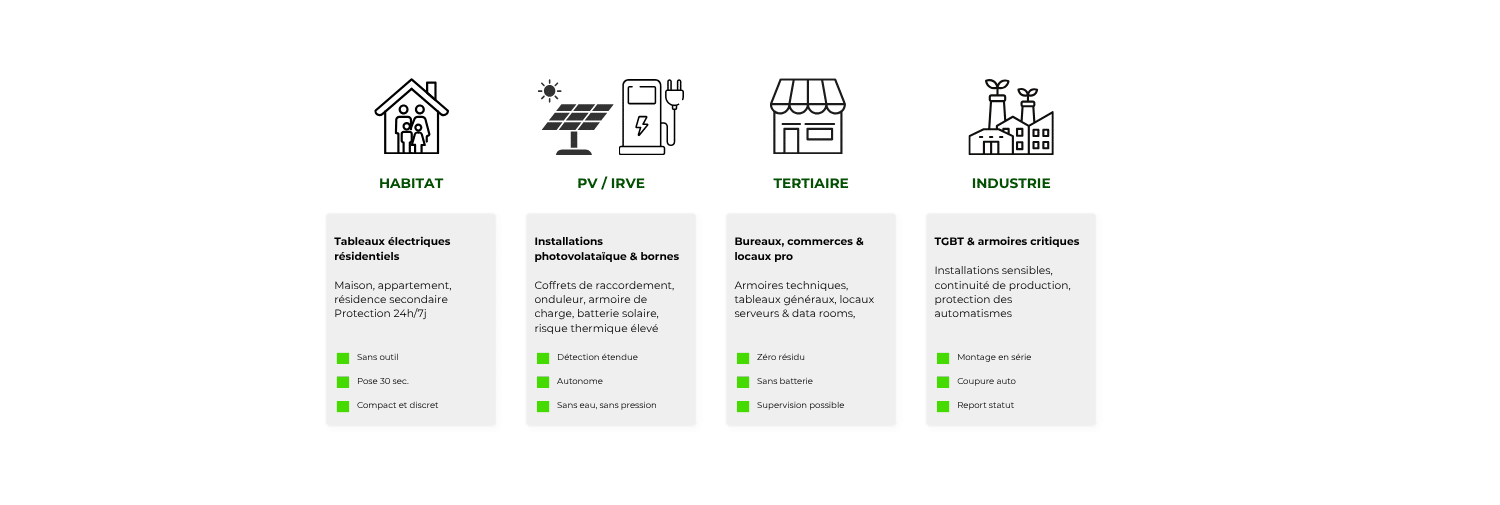
Selection should combine protection objective, detection, sizing, installation and business continuity.
Before choosing a system, define your protection objective
Two identical installations may require different strategies depending on what the operator wants to preserve.
Objective 1: protect the building
The priority is to protect people, limit propagation and preserve the site structure.
- Building-wide detection
- Alarm and evacuation
- Compartmentation
- Intervention resources
- Possible room protection
Objective 2: protect the building and preserve the installation
The strategy also aims to avoid destruction of the cabinet and operational downtime.
- Detection close to the risk
- Very early activation
- Local equipment protection
- Reduced damage
- Faster restart
At what stage do you want to intervene?
The earlier the intervention, the more damage can be limited.
Overheating
A connection or component begins to rise abnormally in temperature.
First small flame
The flame is still comparable to a lighter or a match.
Propagation
Cables, plastics and nearby components begin to be affected.
Developed fire
The cabinet is heavily damaged and operations are interrupted.
Our objective: act from the first small flame
With linear heat detection installed directly above the risk areas, AeroXSense aims to activate while the flame is still very limited, comparable to a lighter or a match.
No propagation
Adjacent components are generally not yet affected.
Limited damage
Intervention occurs before several electrical components are destroyed.
Reduced downtime
Restart can be faster than after a developed cabinet fire.
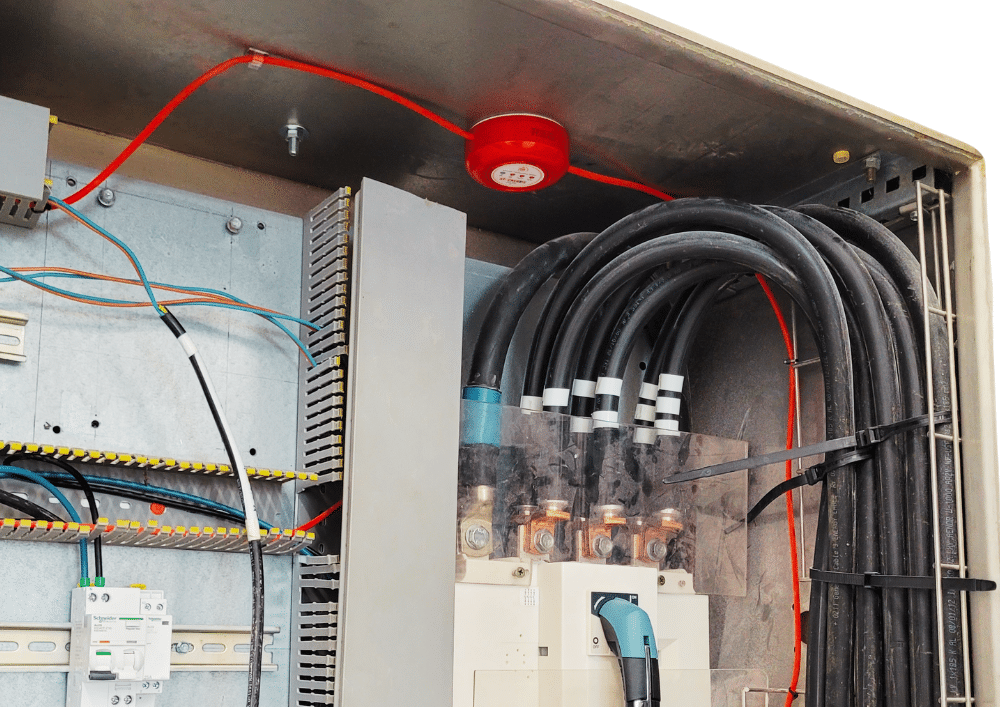
Early intervention depends first on the detection system
An automatic suppression system cannot act before the fire has been detected. Detection located too far away reacts later; detection installed above the risk areas can react earlier.
Terminals and connections
The cable follows tightening points and connection areas.
Breakers and contactors
Switching and control devices are included in the route.
Drives and power supplies
Power electronics are monitored as close as possible.
PLCs and transformers
Critical equipment can be covered according to its position.
Volume is essential, but it is not enough
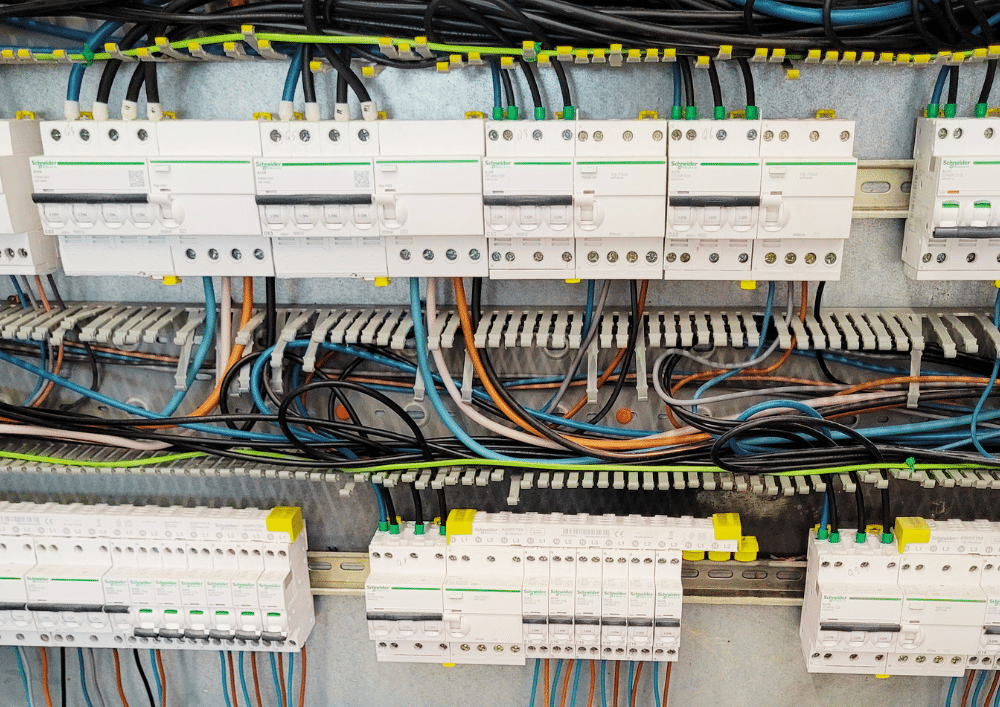
Reliable sizing must consider the actual enclosure geometry and how the extinguishing agent will be distributed.
Useful volume
Determines the minimum amount of extinguishing agent.
Width
Influences range, coverage and the number of generators.
Compartments
May prevent distribution between several zones.
Ventilation
May remove the extinguishing agent from the protected volume.
Cabinet width can completely change the choice
A 40 cm cabinet is not protected in the same way as a 120 or 160 cm cabinet. Detection must cover the full useful width and the extinguishing agent must reach every relevant area.
Compact enclosure
One correctly positioned device may cover the main areas.
Medium cabinet
The detection route must cover both ends.
Large width
Range and obstacles must be assessed carefully.
Very wide cabinet
Several generators may be needed for consistent coverage.
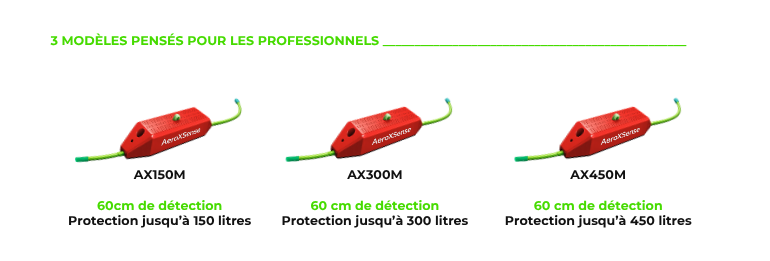
Compartments completely change the strategy
A metal partition or separated cell may block extinguishing agent distribution. Each compartment should then be assessed as a separate volume.
Single cell
A simple volume may use one protection architecture.
Several compartments
Each zone must be assessed separately.
Several generators
Protection is distributed according to the real geometry.
Several detection routes
Detection must follow the risk areas in each cell.
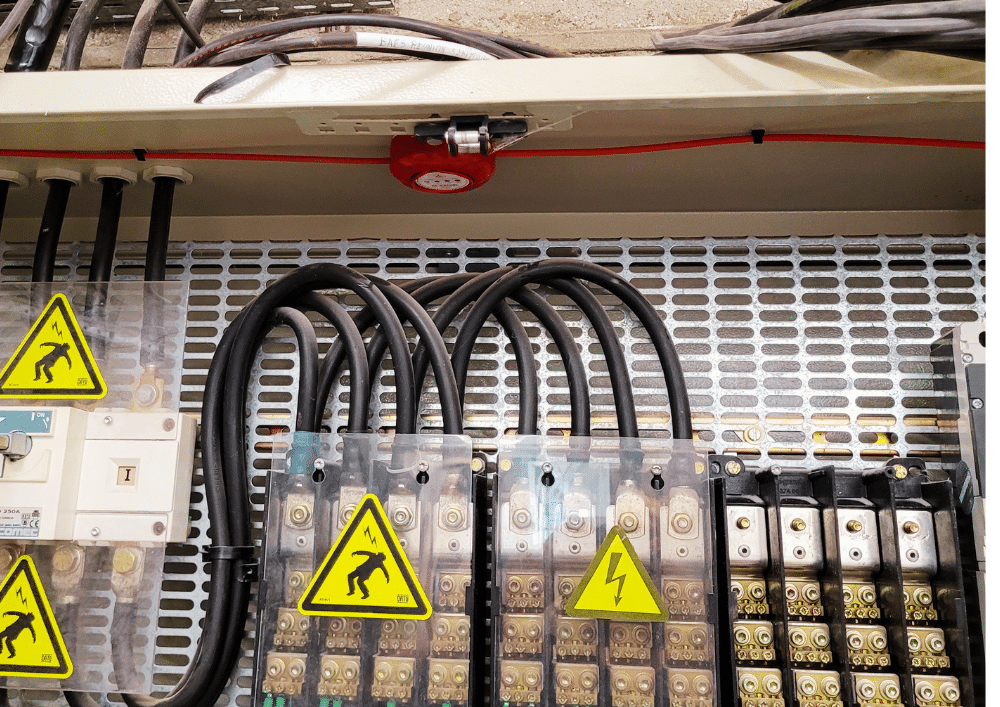
Ventilation directly affects performance
Natural or forced ventilation can change the concentration and holding time of the extinguishing agent inside the enclosure.
Natural ventilation
Openings and grilles must be included in the assessment.
Forced ventilation
Fans may remove the agent very quickly.
Permanent extraction
Coordination with the safety sequence may be required.
Automatic shutdown
An interface can stop ventilation when activation occurs.
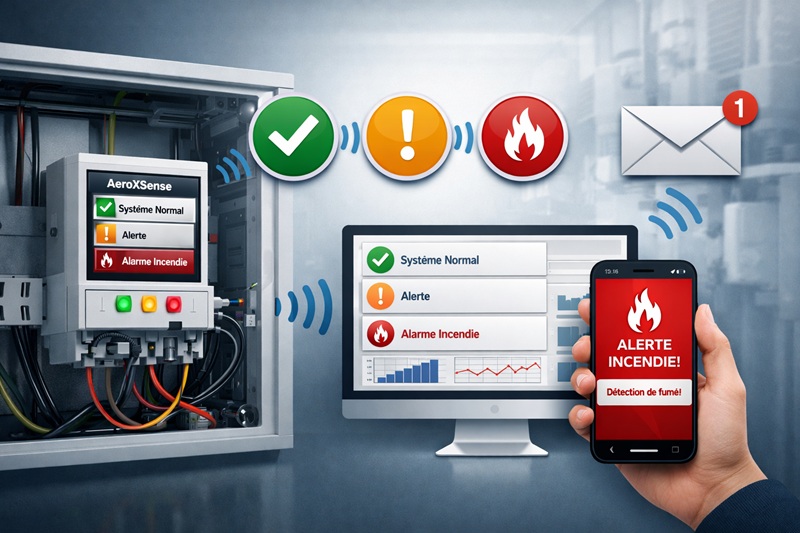
What happens if suppression acts too late?
Even if the fire is eventually extinguished, the consequences can differ greatly depending on the activation time.
Early intervention
Small flame, no propagation, adjacent components preserved, faster restart and reduced operational losses.
Late intervention
Cables, PLCs, drives and protection devices destroyed, cabinet reconstruction, prolonged shutdown and significant operational losses.
Choose the right architecture and product range
The range should not be selected by volume alone. Width, complexity, compartments and integration requirements also matter.
Habitat range
Small electrical panels and compact boxes with simple installation and width-adapted coverage.
Pro range
Professional cabinets, technical enclosures, automation, HVAC, telecom and intermediate volumes.
Industry range
Main switchboards, large cabinets, multi-generator architectures and compartmented installations.
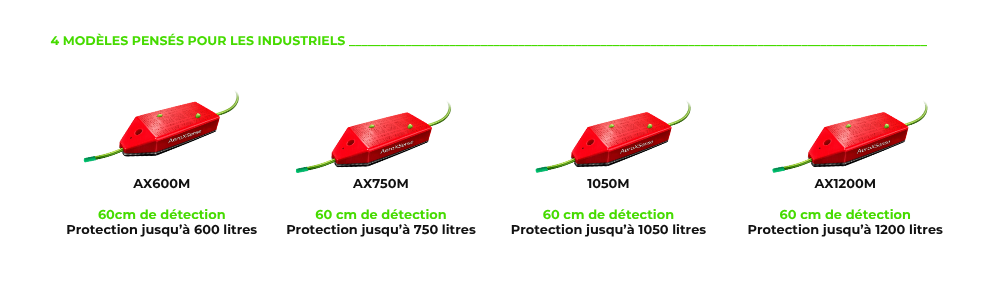
We assess the complete risk before recommending a model
Fire suppression selection should result from a structured study, not from a simple match between volume and model.
| Criterion | Why does it matter? |
|---|---|
| Protection objective | Protect only the building, or also preserve the cabinet and business continuity. |
| Intervention stage | Very small fire start or already developed fire. |
| Detection | Determines response speed and risk-area coverage. |
| Volume | Determines the minimum extinguishing agent capacity. |
| Width and height | Determine real coverage and required range. |
| Compartments | May require several generators and detection zones. |
| Ventilation | Affects agent retention inside the enclosure. |
| Risk areas | Define the heat-sensitive cable route. |
| Business continuity | Influences the required level of early detection, redundancy and monitoring. |
| Interfaces | Enable electrical shutdown, ventilation stop, BMS/SCADA and status reporting. |
| Maintenance | The installation must remain accessible and compatible with future operations. |
| Specific constraints | Temperature, environment, dust, moisture and site requirements. |
Adapt the method to each type of equipment
The criteria remain the same, but their importance varies by application.
Electrical cabinets
Architecture selected according to volume, width and compartments.
Main switchboards
Assessment by cell, busbar and power area.
Automation
Protection of PLCs, drives and power supplies.
Photovoltaic inverters
Ventilation and power-electronics constraints.
IT racks
Protection of power supplies, PDU and network equipment.
Telecom cabinets
Autonomy, remote sites and status reporting.
HVAC and ventilation
Forced airflow, motors and drives.
Industrial prevention
Integrate suppression into a complete risk-control strategy.
Choosing a fire suppression system: key answers
How do you choose a fire suppression system?
What is the first criterion to assess?
Why is detection as important as suppression?
Why is cabinet width important?
Is volume enough to size the protection?
How do you protect a compartmented cabinet?
Can a ventilated cabinet be protected?
How can operational losses after a fire start be reduced?
The best fire is the one that never becomes a developed fire
At AeroXSense, we design systems to intervene from the earliest stages of a fire start. Send dimensions, photos, drawings, compartments, ventilation constraints and operational objectives: we will define a suitable architecture.
