Fire suppression system for telecom cabinets and remote technical sites
AeroXFireshield automatically detects and suppresses fire in telecom cabinets, fibre enclosures, technical shelters, radio equipment and remote installations. Local activation remains independent of communications-network availability.
Autonomous fire protection for a telecom cabinet or remote technical site.
Why are remote telecom cabinets particularly exposed?
The lack of staff increases the delay between fault development and intervention. Automatic local action can limit spread before a technician arrives.
Late detection
Without local protection, a fault may develop before being reported.
Intervention time
Remote or difficult sites take longer to reach.
External heat
Solar gain and high ambient temperature stress power equipment.
Dust and humidity
The environment can degrade insulation, contacts and cooling.
Vandalism and impact
Outdoor cabinets may suffer mechanical damage.
Cable propagation
Cable bundles can carry fire to other equipment.
Which components can cause a fire?
Telecom cabinets combine AC/DC power, communication electronics, backup batteries and ventilation.
Rectifiers and power supplies
AC/DC converters often operate continuously at high load.
Terminals and connections
Loose or corroded connections can create hot spots.
Switches and routers
Boards, supplies and fans operate continuously.
Radio modules
Transmission equipment may concentrate power and heat.
PDUs and protection devices
Internal distribution may suffer overload or faults.
Fans and extractors
Failure can rapidly raise internal temperature.
Backup batteries
Technology, condition and ventilation require specific assessment.
Dense cabling
Bundles may hide faults and promote spread.
Local protection does not depend on the communications network
Remote reporting informs the operator but must not be a condition for activation.
Autonomous local functions
- Thermal detection in the cabinet
- Automatic generator activation
- Suppression without remote command
- Operation even during network loss
Complementary remote functions
- Activation or fault reporting
- Identification of the affected site
- Notification to the operator
- Centralisation of several cabinets depending on version
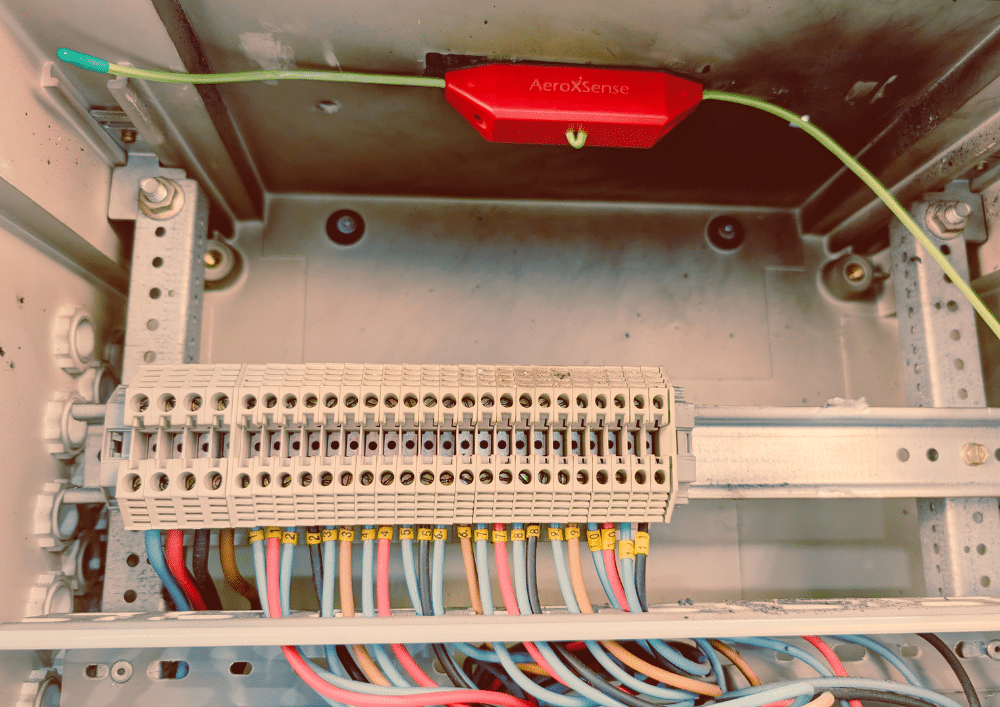
Detect, secure ventilation and act inside the cabinet
The sequence is adapted to ventilation, power architecture and site supervision.
Thermal detection
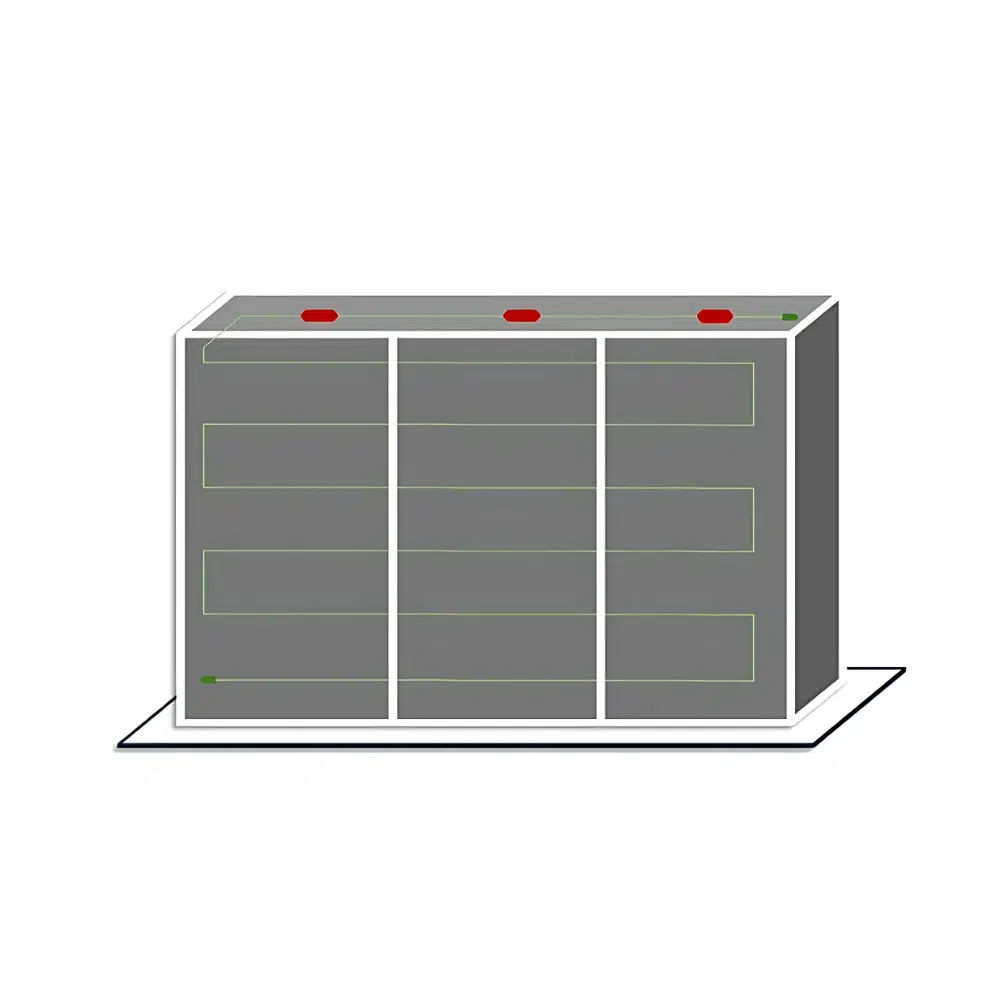
Heat-sensitive cable follows supplies, rectifiers, PDUs and connections.
Fan/extractor shutdown
The interface stops airflow where required.
Generator activation
Aerosol is distributed inside the stabilised technical volume.
Remote reporting
Status is sent to supervision or duty staff depending on version.
Retain the extinguishing agent in the protected volume
Active ventilation may remove aerosol before it can act. Naturally ventilated cabinets must also be assessed for grilles and permanent openings.
Local detection → fan or extractor shutdown command → generator activation → event reporting. A delay or shutdown confirmation can be added depending on the project.
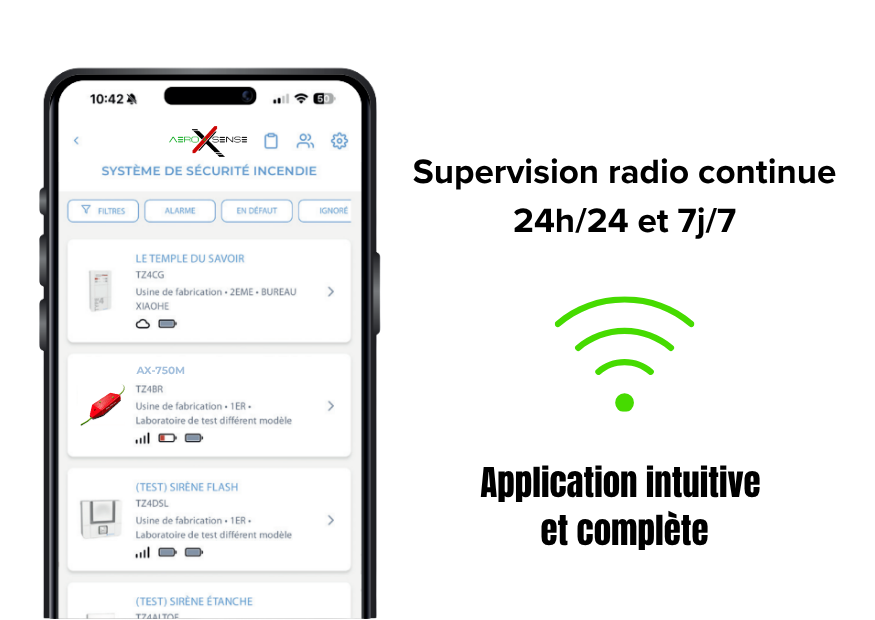
Supervise a fleet of cabinets across several sites
Interfaces report events without making suppression dependent on connectivity.
Dry contact
Reporting to PLC, technical panel or transmitter.
Remote alarm
Indication of activation or available state depending on architecture.
Radio and cloud
Transmission to a remote platform depending on connected versions.
Mobile notification
Alert to operator or on-call staff.
Site identification
Associate the event with the relevant cabinet or shelter.
Multi-site management
Centralise a distributed equipment fleet.
Consider both the cabinet and its environment
Volume, ventilation and outdoor conditions determine selection and layout.
Which approach for each telecom installation?
This table provides guidance subject to technical assessment.
| Configuration | Likely approach | Key consideration |
|---|---|---|
| Compact fibre or transmission enclosure | Pro range depending on volume | Check openings and cabling density |
| Ventilated outdoor radio cabinet | Pro or Industry | Ventilation shutdown during activation |
| Technical shelter | Local or whole-volume protection | Assess several cabinets and shelter volume |
| Cabinet with backup batteries | Specific assessment | Analyse technology, compartments and ventilation |
| Remote 4G/5G site | Autonomous protection with remote reporting | Plan site identification and alerting |
| Several cabinets on one site | Multiple-unit architecture | Coordinate detection, ventilation and supervision |
Limits to integrate from the design stage
Protection must suit the real environment, battery technology and continuity requirements.
Which networks and infrastructures are concerned?
Protection is especially relevant to remote, distributed equipment that supports service continuity.
Telecommunications
Network, transmission and power cabinets.
Fibre optic
Distribution, transmission and active-equipment enclosures.
4G/5G radio
Cabinets and shelters serving radio sites.
Railway
Signalling, telecom and trackside cabinets.
Roads and tunnels
Communication, safety and operating equipment.
Urban video surveillance
Network cabinets, recorders and supplies.
Pumping stations
Control, communication and remote monitoring.
Energy
Technical stations, metering and remote control.
Ports and airports
Networks, guidance and security equipment.
Multi-site industry
Technical cabinets spread across large sites.
Public authorities
Urban networks and isolated public equipment.
Public transport
Telecom, passenger information and control.
Build a coherent strategy around telecom sites
Server racks
Compare with indoor server and network-rack protection.
Electrical cabinets
Explore protection for professional enclosures.
Sizing
Select models by volume, ventilation and compartments.
Interfaces and shutdown
Fan shutdown, remote reporting and supervision.
Condensed aerosol
Understand how the extinguishing agent works.
Lithium batteries
Separate electronics protection from battery risk.
Electrical rooms
Assess complete shelters and technical rooms.
Professional ranges
Compare Pro and Industry models.
Frequently asked questions about telecom-cabinet fire protection
Comment protéger une armoire télécom contre l’incendie ?
La protection combine détection thermique locale, générateur dimensionné pour l’armoire, arrêt de ventilation si nécessaire et report distant vers l’exploitant.
Le système fonctionne-t-il sans réseau ?
Oui. La détection et l’activation sont locales. Le réseau sert uniquement au report et à la supervision selon la version.
Faut-il arrêter les ventilateurs lors de l’activation ?
Oui pour une armoire fortement ventilée. La commande d’arrêt limite l’évacuation de l’aérosol.
Comment commander l’arrêt de l’extracteur ?
Une interface pilote un relais, contacteur ou entrée externe selon le schéma validé.
Peut-on superviser plusieurs centaines de sites ?
Une architecture multi-sites peut centraliser les événements selon la version et le service retenus.
Peut-on protéger un shelter télécom complet ?
Oui, soit par protection localisée des armoires, soit par étude du volume global, soit par combinaison des deux.
Comment traiter les batteries de secours ?
Il faut identifier leur technologie, leur compartiment, leur ventilation et le risque associé. Les batteries lithium nécessitent une étude spécifique.
Peut-on protéger une armoire extérieure ?
Oui si les conditions environnementales, la ventilation, les ouvertures et l’implantation sont compatibles.
Le système peut-il couper l’alimentation ?
Une interface peut commander un organe externe, mais la stratégie doit préserver les fonctions critiques nécessaires.
Comment identifier le site qui a déclenché ?
Le report distant peut associer l’événement à un identifiant d’armoire ou de site.
La connectivité est-elle obligatoire ?
Non. Elle complète la protection autonome sans conditionner l’activation.
Peut-on protéger une armoire naturellement ventilée ?
Oui dans certaines configurations, après étude des grilles et des pertes potentielles d’agent.
Quelle différence avec une baie informatique ?
L’armoire télécom est souvent extérieure ou isolée, soumise à des conditions plus sévères et à un délai d’intervention plus long.
Que faire après une activation ?
Mettre le site en sécurité, identifier la cause, inspecter et nettoyer l’armoire, remplacer les éléments activés et valider la remise en service.
Quelles informations transmettre pour une étude ?
Dimensions, photos, ventilation, ouvertures, équipements, batteries, température ambiante et besoins de report ou de coupure.
Do you have a telecom cabinet or remote site to protect?
Send dimensions, photographs, ventilation, equipment, batteries and remote-reporting requirements. We will define the model, detection route, ventilation shutdown and supervision architecture.