AeroXFireshield Residential Range: automatic fire suppression for electrical panels
Compact, autonomous systems designed and manufactured in France to detect and suppress a fire at a very early stage inside consumer units, distribution boards and small technical enclosures. The AeroXFireshield Residential Range protects circuit breakers, terminals, busbars, contactors and connected electrical equipment before flames spread beyond the panel.
Compact protection installed directly inside the electrical panel, close to the potential fire source.
Why can an electrical panel catch fire?
Electrical panels contain multiple potential ignition points. A room smoke detector may only react after smoke has already escaped the enclosure and substantial damage has occurred inside.
Loose connections
Poorly tightened terminals can create increasing electrical resistance and heat.
Busbars and terminal blocks
Distribution points can carry high current and concentrate thermal stress.
Breakers and contactors
Switching and protection devices may develop internal faults or arcing.
Solar and auxiliary equipment
Additional devices increase the number of components and connections to monitor.
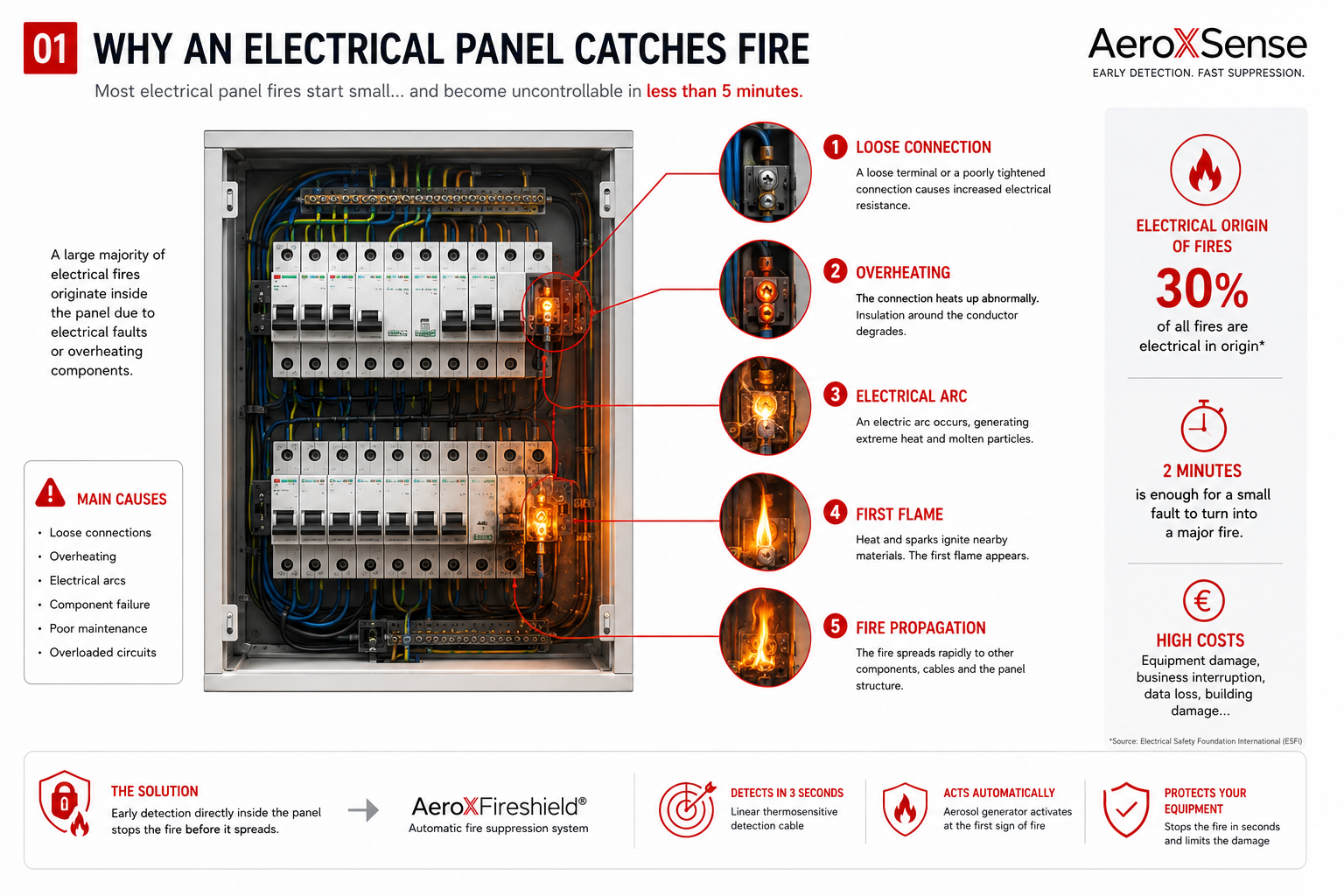
An electrical fire often begins with one localised fault before spreading rapidly to nearby wiring and devices.
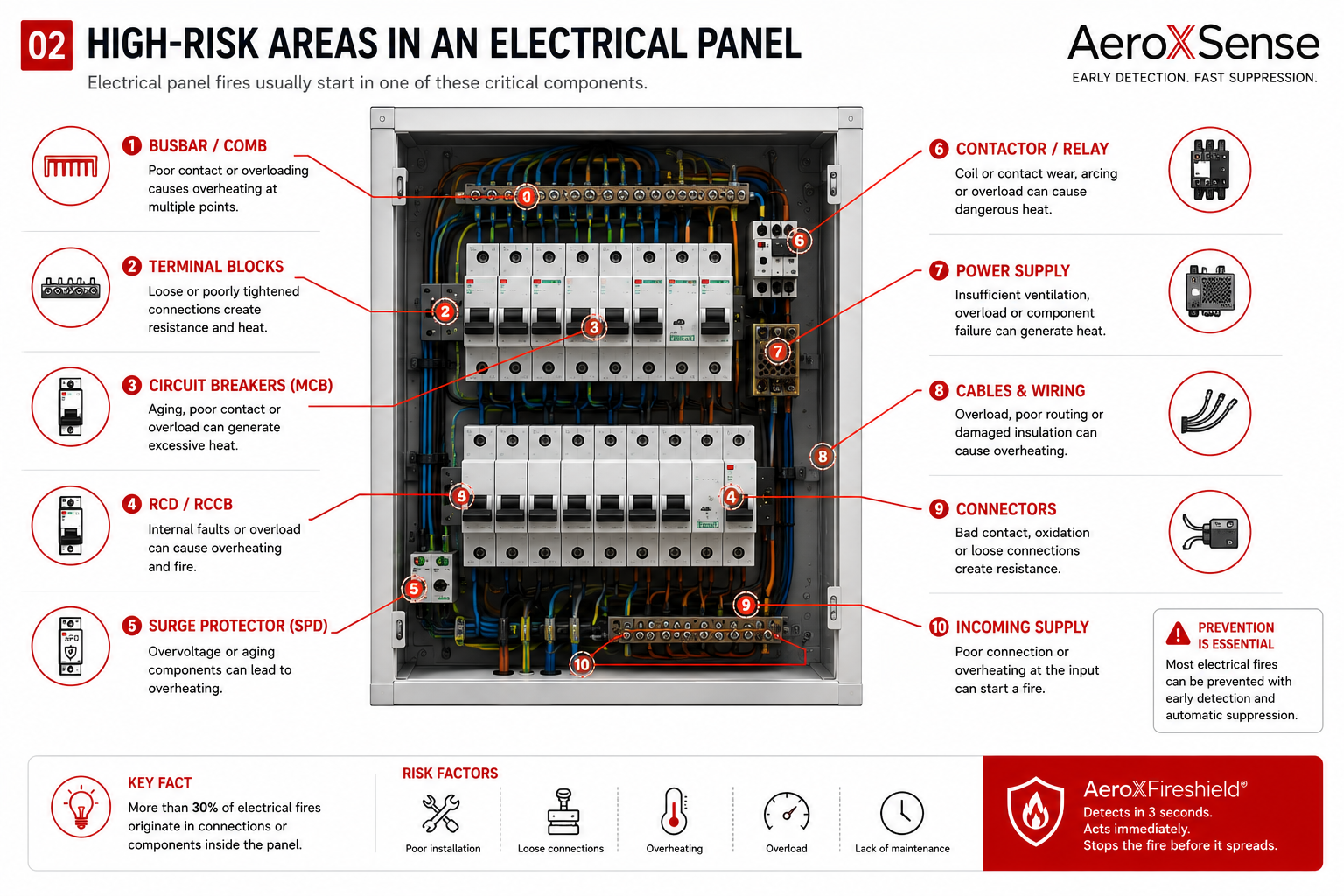
The main ignition points are connections, switching devices, power supplies and components exposed to overheating.
Detect the first small flame directly inside the panel
The linear thermosensitive cable is installed at the top of the panel, above circuit breakers and the main electrical risk areas. The objective is to react while the flame is still comparable to a lighter or match, before neighbouring cables and devices become involved.
Detection at source
The cable is located inside the same enclosure as the electrical fault.
Reduced equipment damage
Suppression begins before several devices are destroyed.
Limited fire spread
The fire has less time to leave the panel and involve the room.
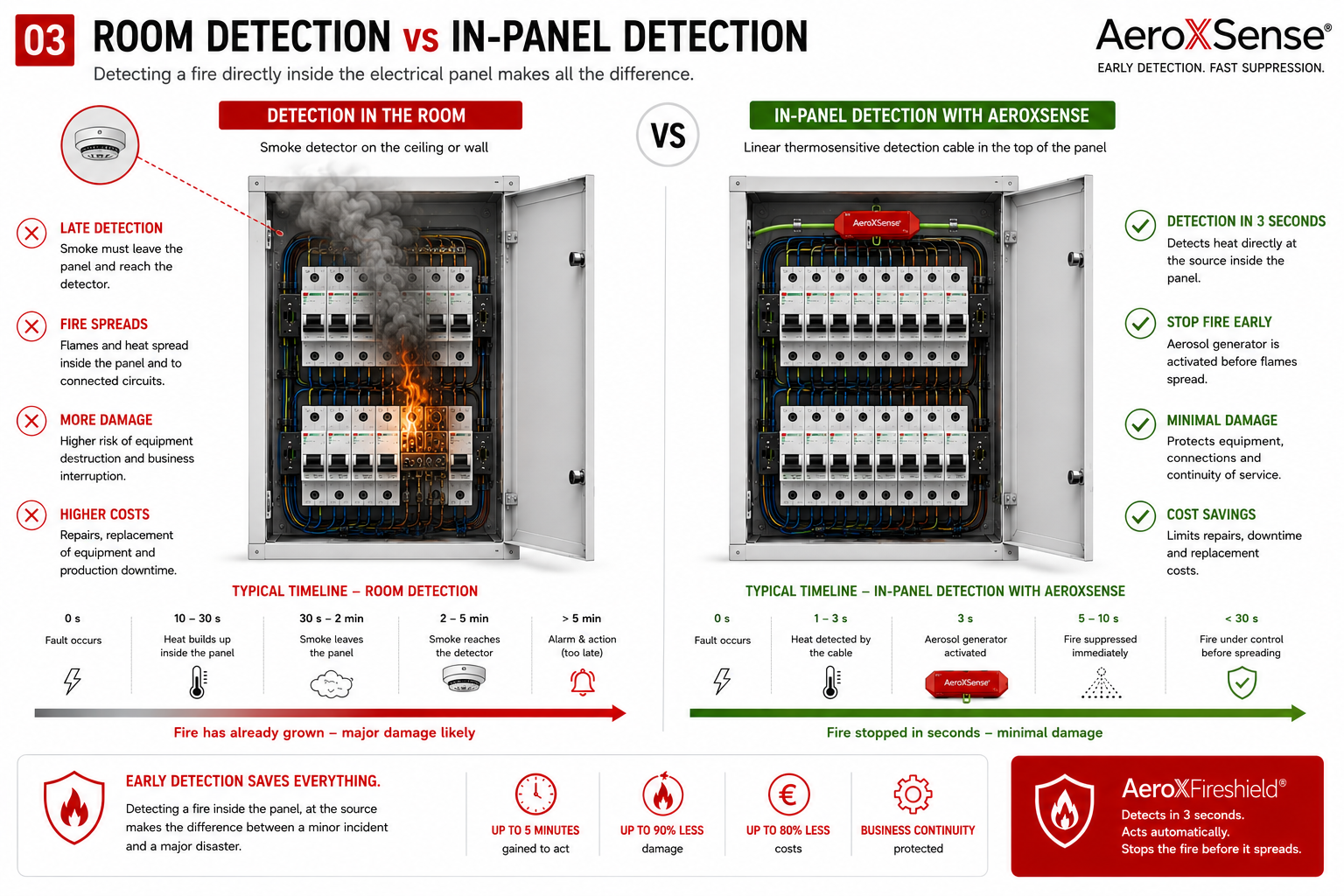
In-panel detection reacts before smoke reaches a detector mounted in the room.
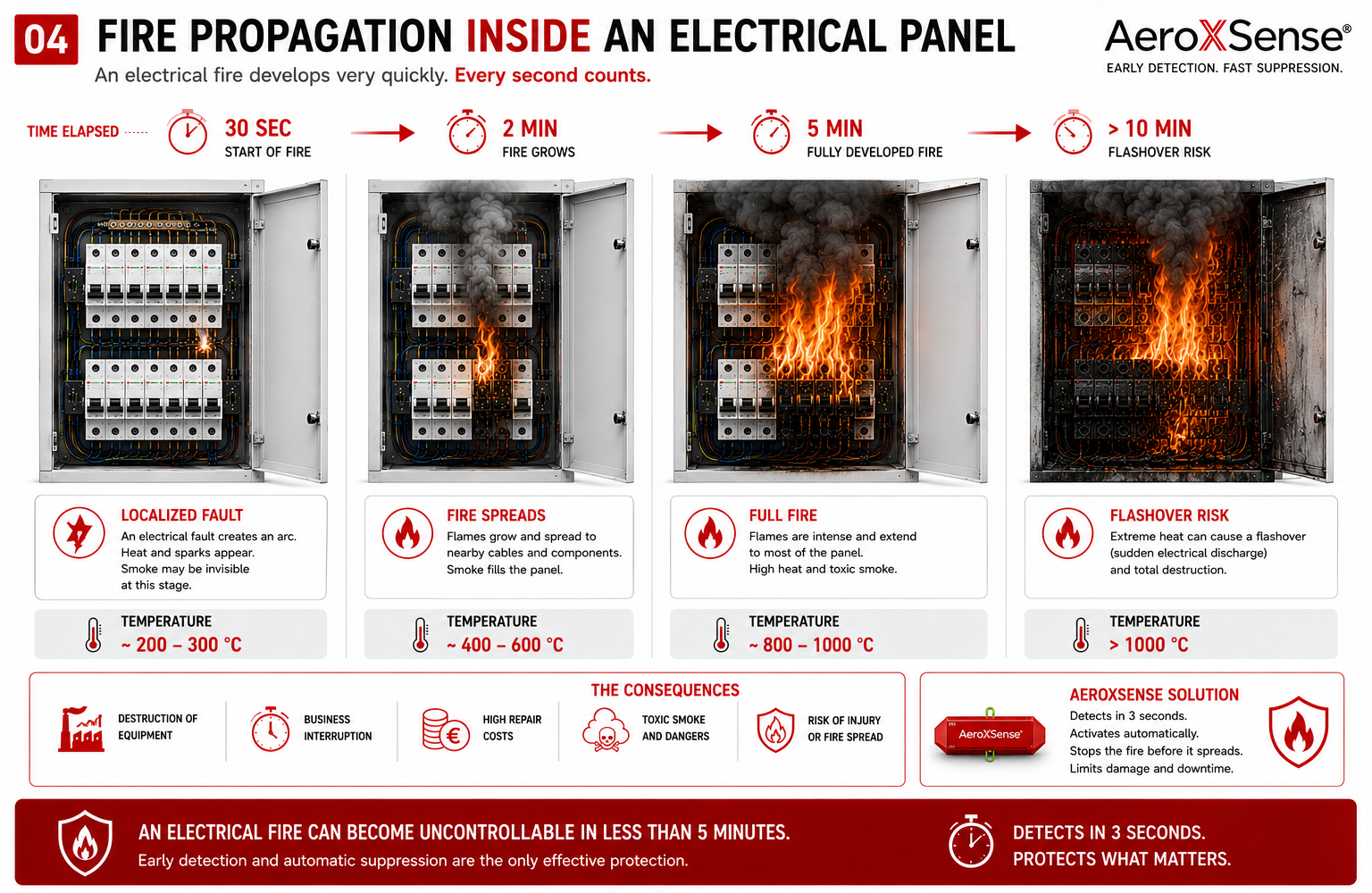
A localised electrical fault can become a major fire in only a few minutes.
Automatic detection and fire suppression without a control panel
The Residential Range does not require a central fire alarm system to detect and activate the generator.
Monitoring
The detection cable covers the panel width and main risk areas.
Fire starts
Heat or direct flame activates the thermosensitive detection element.
Generator activates
The device releases condensed aerosol inside the protected enclosure.
Combustion is interrupted
The aerosol inhibits the chemical chain reactions that sustain the flame.
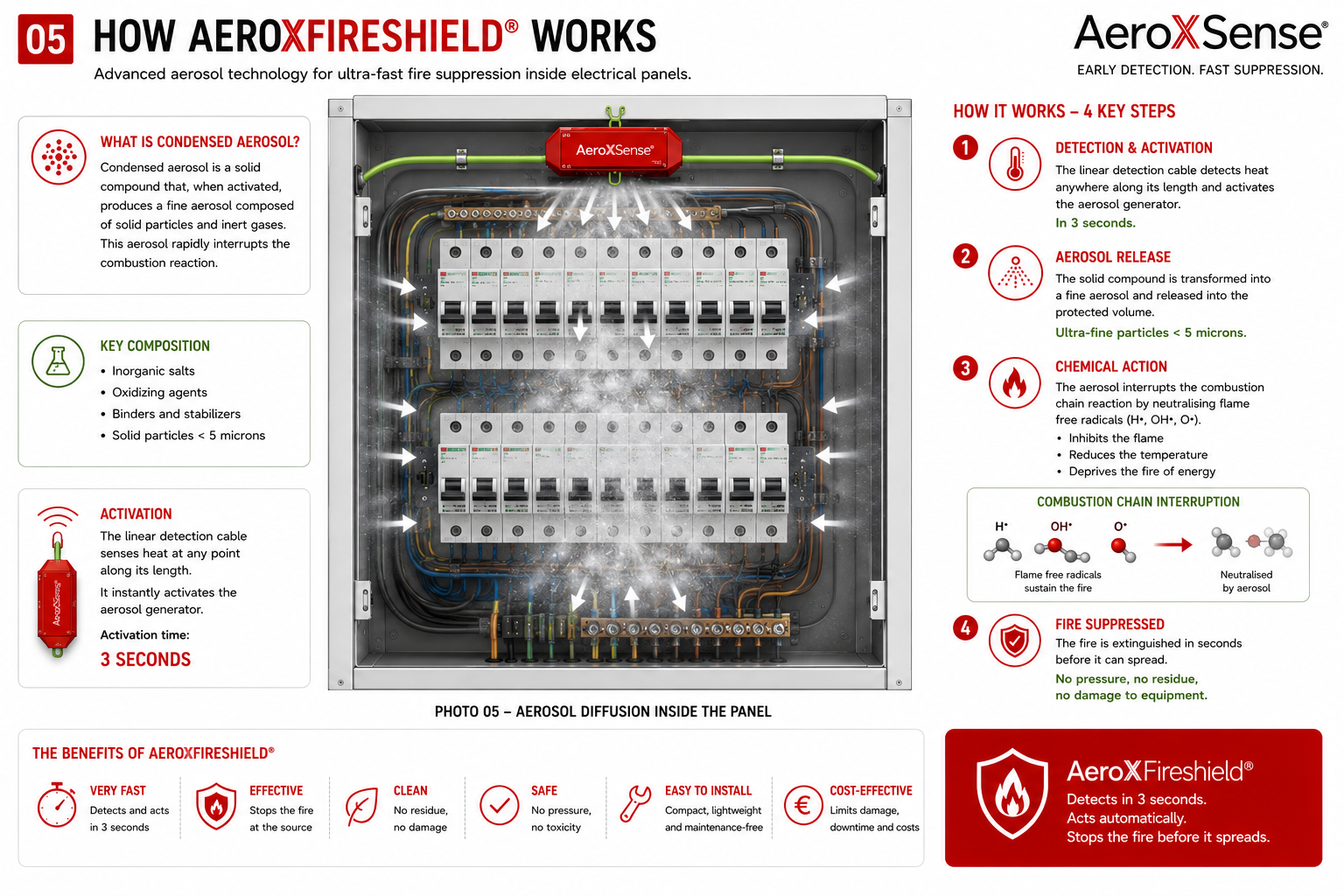
After activation, the aerosol fills the protected volume and interrupts the combustion chain reaction.
Select the model according to panel width, not volume alone
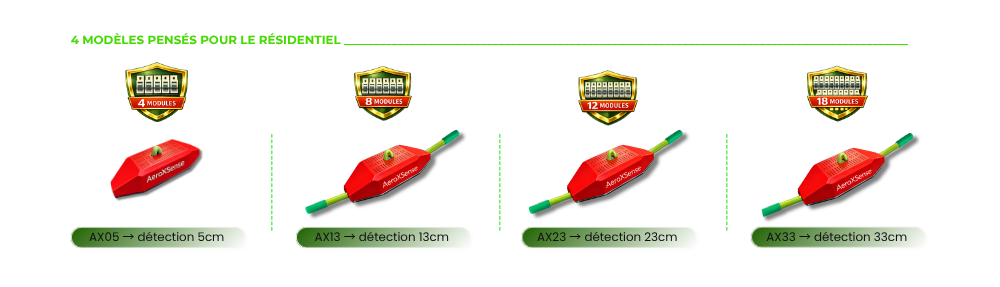
The generator body remains compact. The detection cable length changes according to the model so that the full usable width of the panel can be covered.
Aero-X05-Fireshield
Indicative coverage: 6 cm
No external detection cable. Intended for very small enclosures up to approximately 4 modules.
Aero-X13-Fireshield
Indicative coverage: 13 cm
For compact distribution boards up to approximately 8 modules.
Aero-X23-Fireshield
Indicative coverage: 23 cm
For standard consumer units and distribution boards up to approximately 12 modules.
Aero-X33-Fireshield
Indicative coverage: 33 cm
For wider residential panels up to approximately 18 modules and multi-row installations.

The generator size remains fixed; the detection cable length changes according to the selected model.
Residential Range overview
| Model | Indicative coverage | Typical application | Detection |
|---|---|---|---|
| Aero-X05 | 6 cm | Very small enclosures | Integrated detection |
| Aero-X13 | 13 cm | Compact consumer units | Linear cable |
| Aero-X23 | 23 cm | Standard distribution boards | Linear cable |
| Aero-X33 | 33 cm | Wide residential panels | Linear cable |
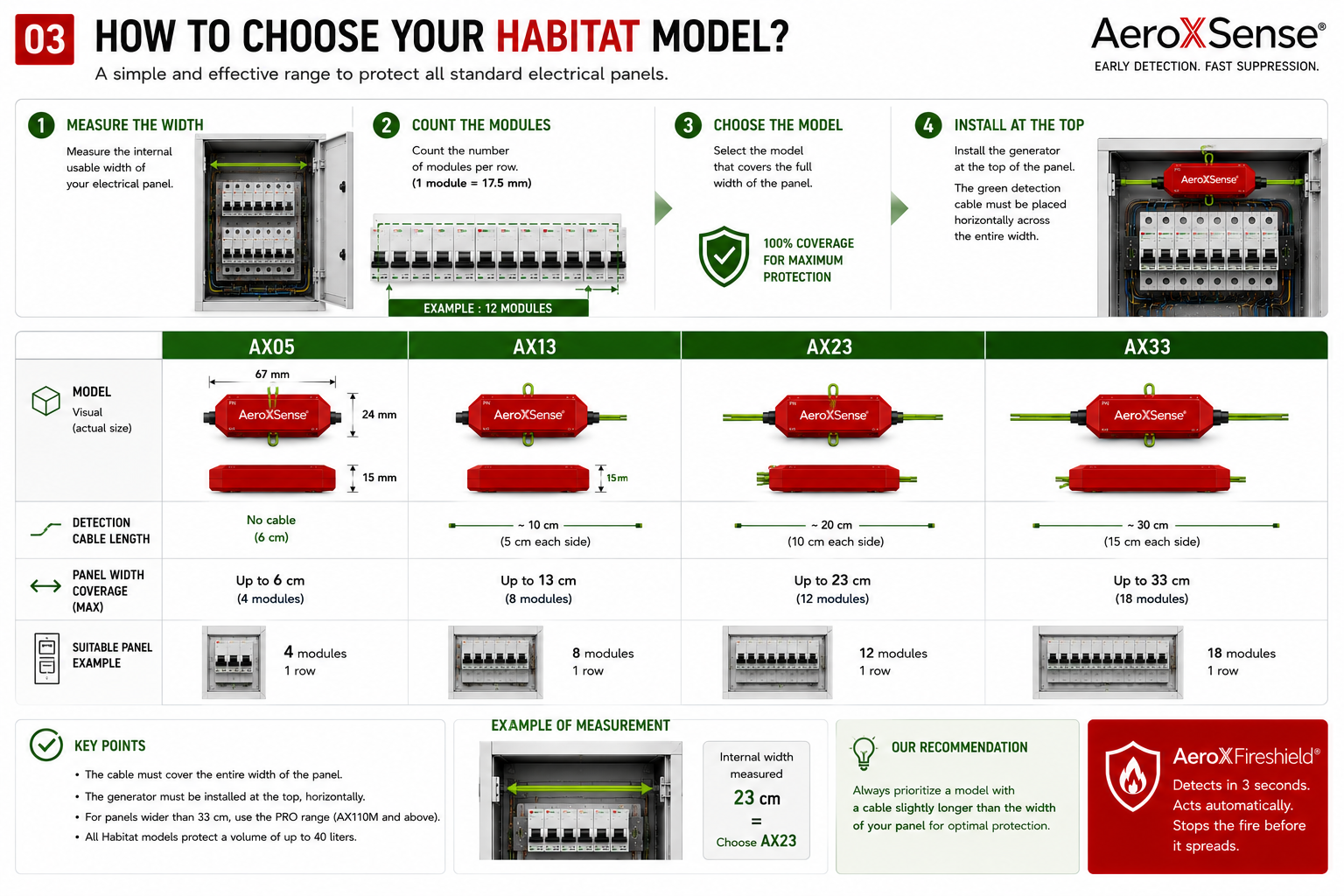
Measure the usable width, count the modules and select a model whose detection cable covers the complete panel width.
A wide distribution board cannot be protected like a four-module enclosure
A model with insufficient cable coverage may leave some risk areas too far from the detection element.
Full usable width
The detection cable should cover the complete width of the panel.
Main risk rows
The most significant electrical rows must remain close to the detection path.
Side terminals
Lateral terminals and incoming connections must be included.
Additional devices
Solar protection, contactors and automation equipment must remain covered.
Why install the generator at the top of the electrical panel?
The device is normally installed horizontally in the upper part of the enclosure, according to the installation instructions, without obstructing the breakers or maintenance access.
Upper position
The generator is installed above the electrical devices.
Correct orientation
The product orientation follows the manufacturer’s instructions.
Horizontal detection cable
The cable covers the panel width at the top.
Maintenance access preserved
The system must not obstruct access to the panel.
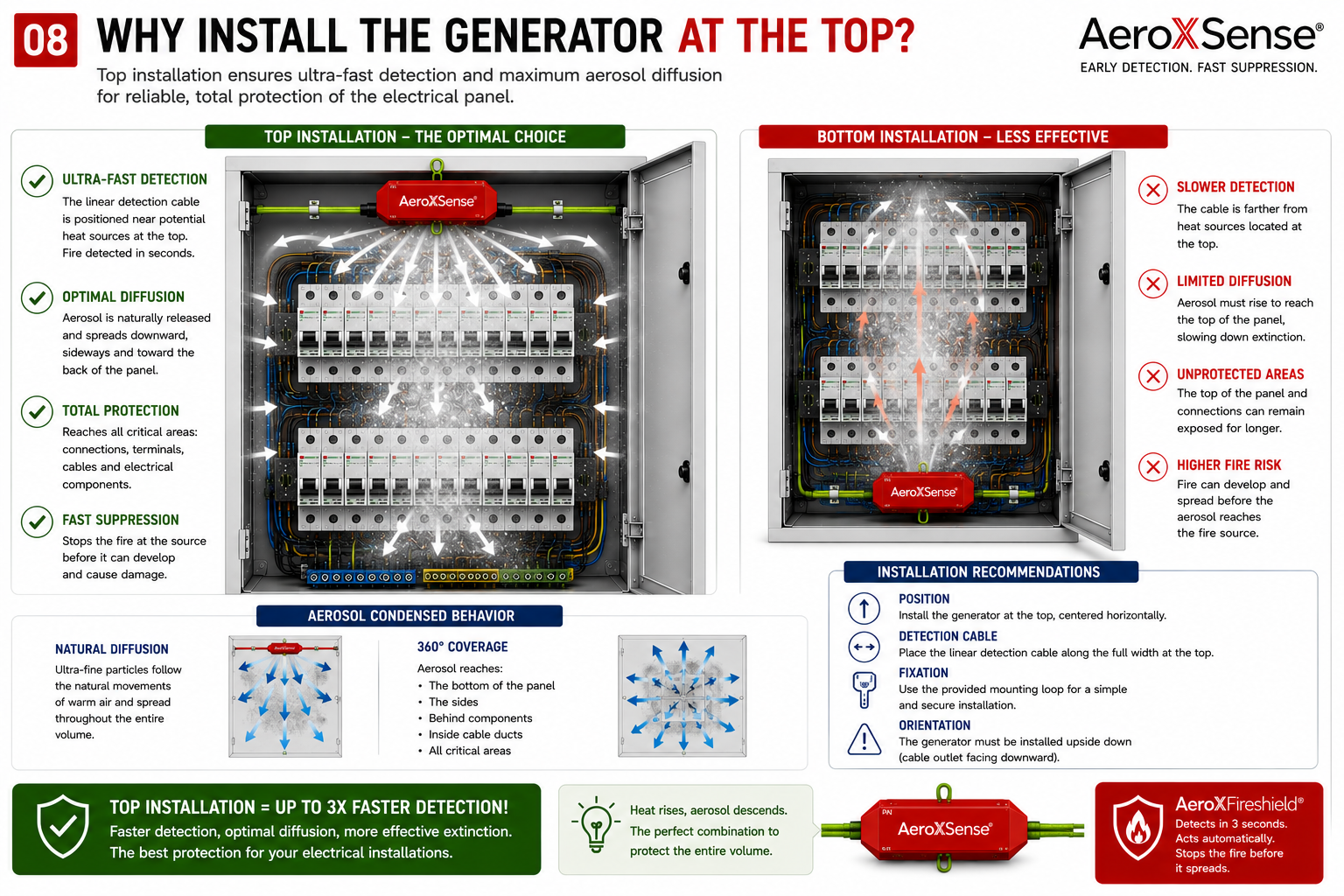
Top installation places the detection cable near rising heat and supports effective aerosol distribution throughout the enclosure.
Automatic fire suppression for many small electrical enclosures
Homes
Main consumer units and sub-distribution boards.
Small Commercial Premises
Shops, offices and compact technical areas.
Residential Solar
AC/DC protection boards and associated electrical equipment.
Pool Control Panels
Pumps, contactors and automation equipment.
Motorhomes
Small electrical enclosures, subject to installation review.
Boats
Electrical panels and compact technical compartments.
Garages and Outbuildings
Workshops, annexes and isolated technical spaces.
Small Technical Enclosures
Gates, automation and auxiliary systems where suitable.
Simple, local and autonomous protection
Autonomous
No fire alarm panel or mandatory external connection.
Fast installation
Direct installation inside the panel by a competent professional.
Local action
The extinguishing agent is released directly into the protected enclosure.
Compact format
Designed for consumer units and small technical enclosures.
What the Residential Range does — and what it does not replace
What it provides
- Very early local detection
- Autonomous activation
- Suppression directly inside the panel
- Reduced fire propagation
- Complementary protection for the building
What it does not replace
- Smoke alarms
- Building fire protection
- Repair of defective electrical installations
- Electrical inspection and maintenance
- Correct product selection and installation
A range designed for installers, distributors and end users
For Electricians
A simple additional product, fast installation and a clear way to enhance protection in new or existing panels.
For Distributors
Four main references, straightforward stock management and dedicated technical and commercial support.
For End Users
The correct model can be reviewed from photographs, panel width, number of rows and internal dimensions.
Plan your electrical panel protection project
Electrical Panel Protection
Automatic suppression for breakers and terminals.
Photovoltaic Protection
AC/DC panels and solar electrical equipment.
Pool Control Panels
Pumps, contactors and automation.
Linear Heat Detection
Understand detection cable positioning.
System Sizing
Width, rows, volume and risk areas.
Mistakes to Avoid
Avoid incorrect model selection and installation.
Compare All Ranges
Residential, Professional and Industrial solutions.
Professional Range
For cabinets and enclosures beyond Residential capacity.
AeroXFireshield Residential Range
Which model should I choose for my electrical panel?
Does the Residential Range work without mains power?
Where should the generator be installed?
Must the detection cable cover every row?
Can a solar distribution board be protected?
Can a pool control panel be protected?
Does the product replace a smoke alarm?
Who should install the system?
Protect your electrical panel before a small fault becomes a major fire
Send us a photograph, usable width, number of rows and internal dimensions. We will help identify the appropriate AeroXFireshield Residential model.