Fire suppression system for an electrical panel
AeroXFireshield detects a fire starting directly inside the electrical panel and automatically releases a condensed aerosol fire suppressant as close as possible to the source of the fire. The Habitat line offers electricians and retailers a compact solution that uses no water and no pressurized cylinders, suitable for electrical panels and small enclosures.
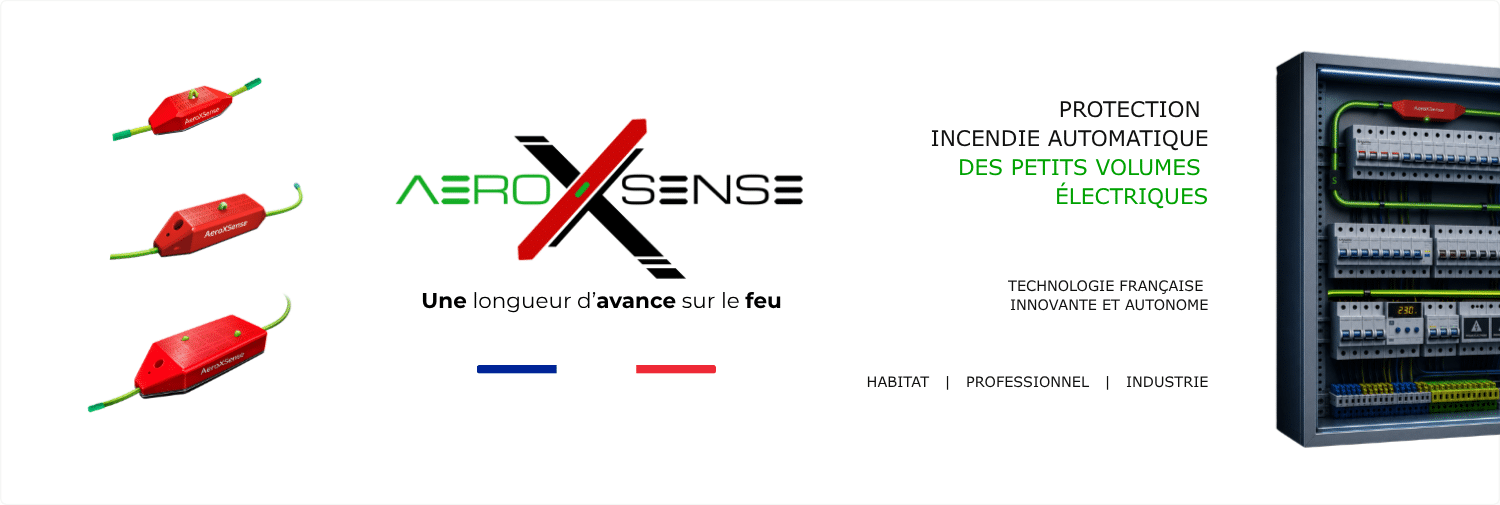
Automatic protection installed directly inside the electrical panel, with linear thermal detection positioned above the components and connections to be monitored.
A fire can start in an enclosed space that is not easily visible
The panel houses electrical connections, protective devices, and components. A localized fault may start behind the cover, develop without being immediately visible, and spread to the cables, surrounding materials, or the building.
Overheating at a connection
Improper tightening, a degraded connection, or contact resistance can cause a gradual rise in temperature.
Electric arc or short circuit
A faulty insulation, a damaged component, or an electrical arc can cause a fire to start near combustible materials.
Propagation outside the enclosure
If a fire is not extinguished quickly, it can spread to the conductors, the cable duct, the walls, and nearby equipment.
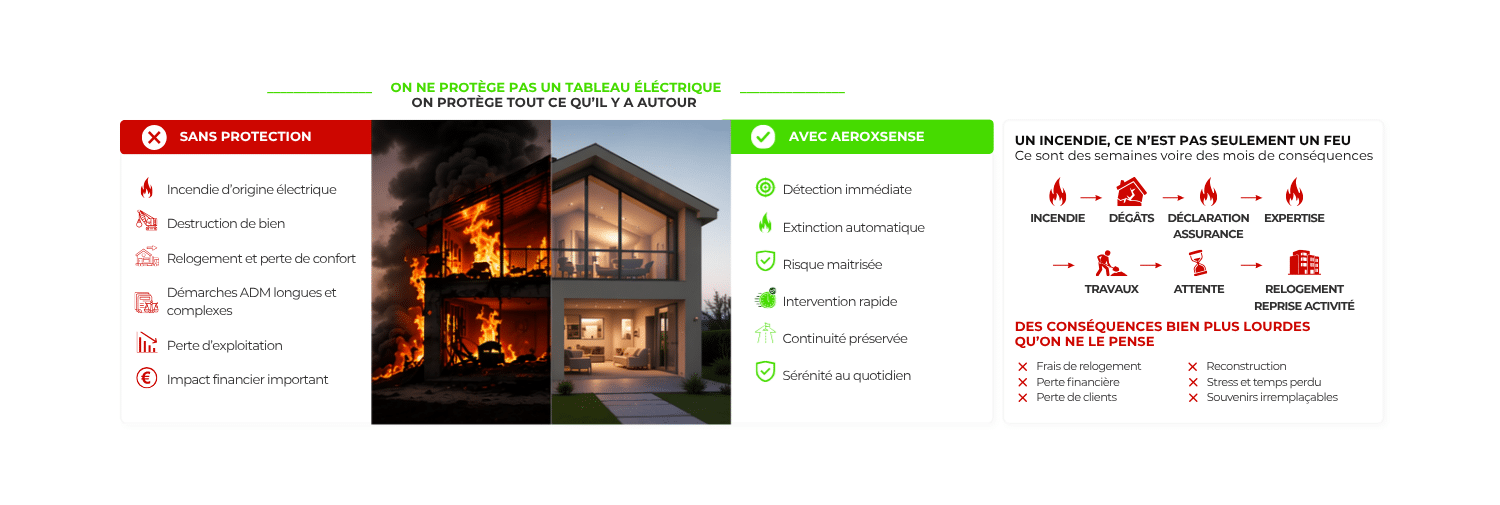
Taking action as close to the source of the fire as possible is intended to limit the spread before the fire spreads beyond the panel.
Detect, activate and suppress the fire as close to the source as possible
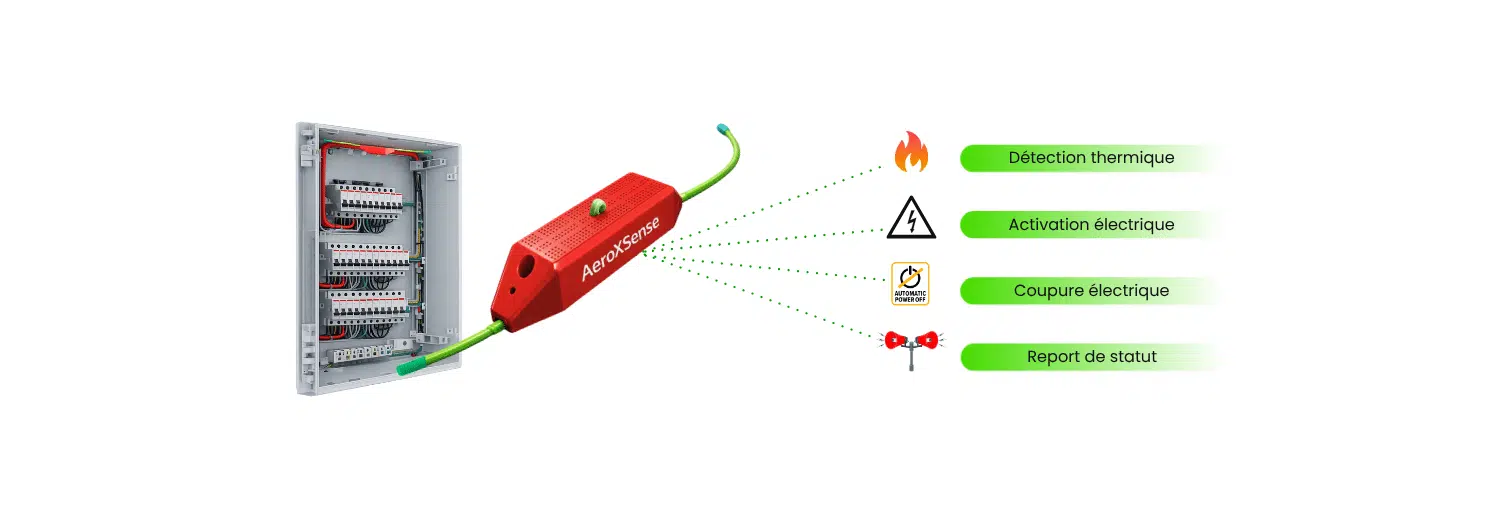
AeroXFireshield combines linear thermal detection with a condensed aerosol generator. The system operates locally within the electrical panel.
Heat Detection
The temperature-sensitive cable is positioned above the connections and components that need to be monitored.
Automatic Activation
When the set temperature threshold is reached, the system starts the generator without human intervention.
Aerosol Generation
The solid formulation produces a cloud of active particles that are dispersed throughout the panel.
Flame suppression
The aerosol primarily acts on the chemical reaction, that sustains combustion, causing the flame to die out.
Four sizes to accommodate the most common panel widths
The Aero-X05, Aero-X13, Aero-X23, and Aero-X33 models are designed for small electrical enclosures. The choice depends first on the width to be protected, and then on the number of rows, the interior volume, and the available space at the top.
Very compact panels
Format designed for small panels or enclosures with a usable width of approximately four modules.
Compact Panels
Recommended for panels of approximately eight modules;, subject to volume and internal configuration.
Standard electrical panels
A format designed for panels of about twelve modules that are very common in residential settings and small commercial spaces.
Extra-wide electrical panels
Recommended for panels consisting of approximately eighteen modules, when the entire width needs to be covered.
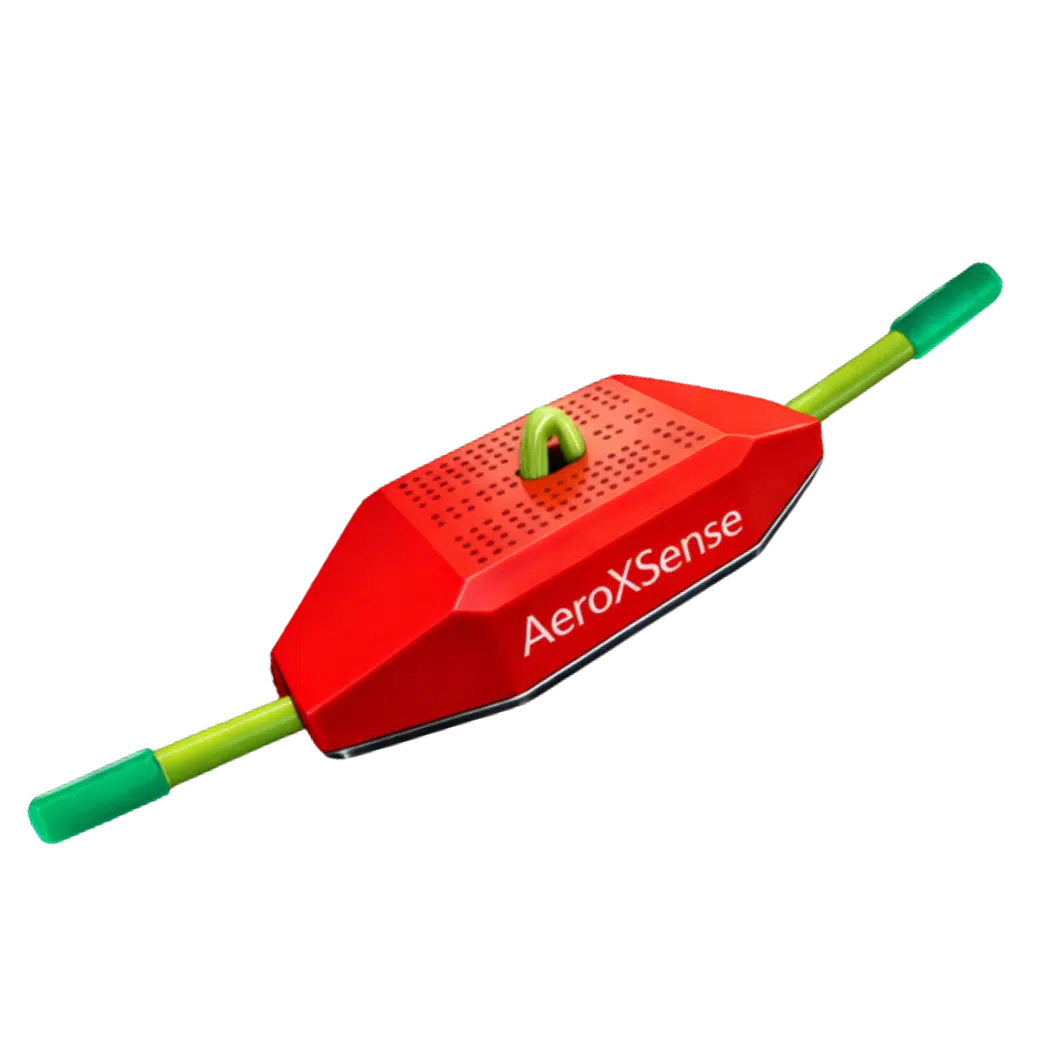
The Habitat line covers the main sizes of electrical panels, ranging from small enclosures to panels with eighteen modules.
How do you choose the right automatic fire suppression device for an electrical panel?
A device that is too short may not cover the entire width,, while a choice based solely on volume may overlook certain rows or connection areas.
Panel width
The length of the product must be consistent with the width of the rows and the electrical area to be protected.
Number of rows
The detection system must monitor the various risk areas and not be limited to a single row.
Interior volume
The capacity of the reference device must remain compatible with the enclosed volume into which the aerosol will be dispensed.
Available installation space
The product must be installable at the top of the panel without preventing the cover from closing or interfering with other equipment.
| Panel width | Approximate orientation | Additional checks |
|---|---|---|
| About 4 modules | Aero-X05 — 6 cm | Interior volume, upper space, and detection path. |
| About 8 modules | Aero-X13 — 13 cm | Number of rows, components included, and actual width of the cabinet. |
| About 12 modules | Aero-X23 — 23 cm | Coverage of width, volume, and the presence of separate zones. |
| About 18 modules | Aero-X33 — 33 cm | Overall width, depth, rows, and available layouts. |

The width in modules serves as a selection guide but it does not replace a check of the volume and interior layout.
A simple installation that must take into account the areas to be protected
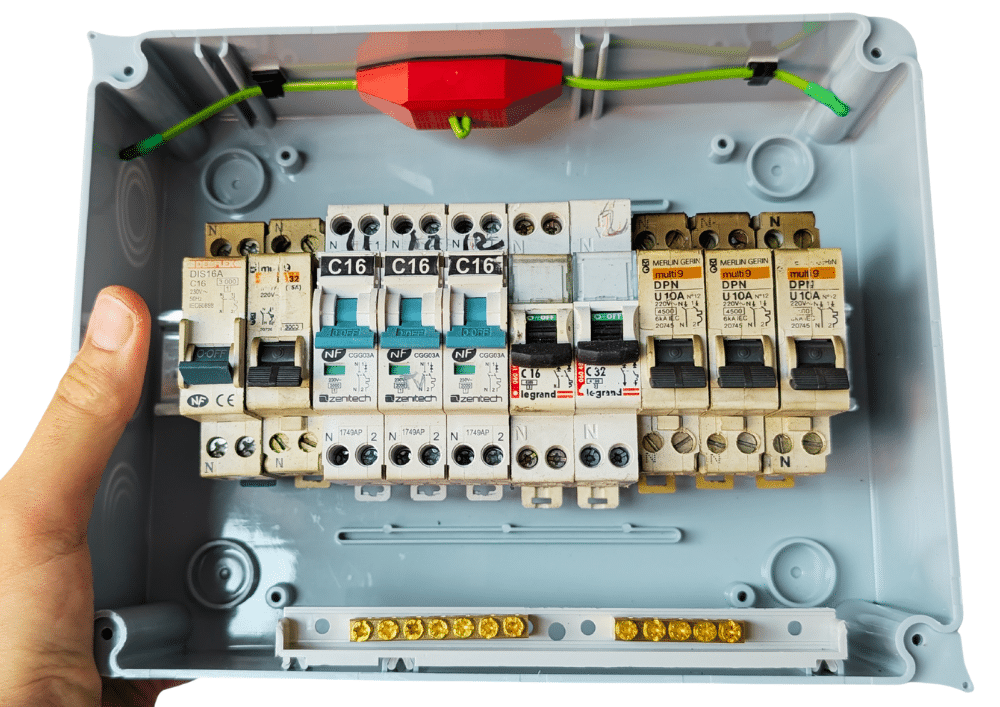
The speed of installation should not result in arbitrary placement. The product and the heat-sensitive cable must be positioned in accordance with the user manual and the panel configuration.
Prepare the surface
- Turn off and secure the power supply
- Open the panel and check the available space
- Clean and degrease the mounting area
Place at the top
- Follow the specified installation direction
- Do not obstruct the aerosol outlet
- Check to make sure the hood closes properly
Cover the high-risk areas
- Prioritize detection over connections
- Take all relevant rows into account
- Check the fasteners before restoring power
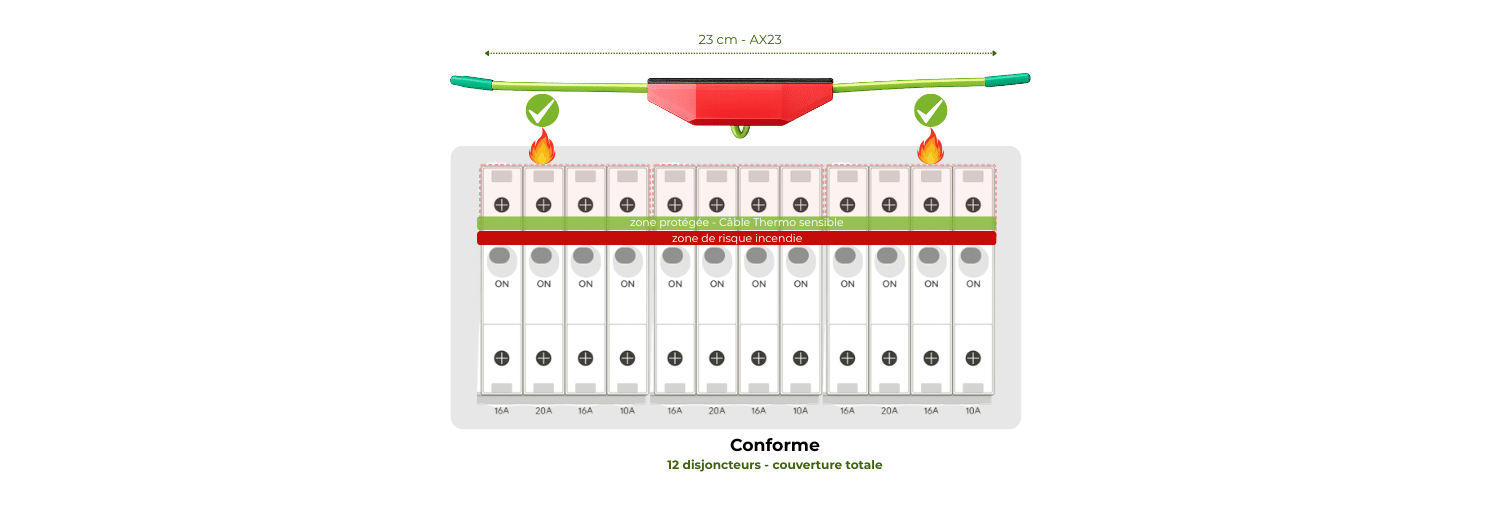
Example of an installation at the top of an electrical panel with a layout that is consistent with the width to be protected.
When should you recommend protection for the electrical panel?
AeroXFireshield can be integrated at various stages of the customer journey from in-store sales to renovation projects or the installation of new electrical equipment.
When replacing an electrical panel
Add automatic fire protection to the renovation quote,, whether it involves safety upgrades or the installation of a secondary electrical panel.
In addition to electrical equipment
Advise the customer based on the width of the electrical panel and submit unusual configurations to AeroXSense for approval.
For small compatible cases
Some small sets may be part of the Habitat line. Larger volumes should be directed toward the Pro line.
For upstream panels and enclosures
The Habitat line may be suitable for a small associated electrical panel. Technical cabinets and enclosures fall more under the "Pro" or "Industrial" categories.
When should you upgrade to Pro or Industry protection?
The Habitat line is designed for panels and small enclosures. As soon as the volume, geometry, or criticality increases, a solution designed for cabinets or electrical rooms must be considered.
Fire suppression system for electrical cabinets
Choose the Pro or Industrial series for your project if the equipment exceeds the standard specifications or requires expanded detection capabilities.
- Larger-capacity photovoltaic system or EV charging station
- Control cabinet or PLC
- Several compartments or rows spaced apart
- Need for Custom Linear Detection
- Status report, outage, or monitoring
Fire suppression system for an electrical room
When it comes to protecting a room, several cabinets, or an entire technical space the project falls under the purview of industrial architecture tailored to the scale of the space.
- Electrical room or utility room
- A set of several cabinets or a main low-voltage switchgear panel
- Large volume and complex architecture
- High Stakes for Business Continuity
- Study of Diffusion and Overall Concentration
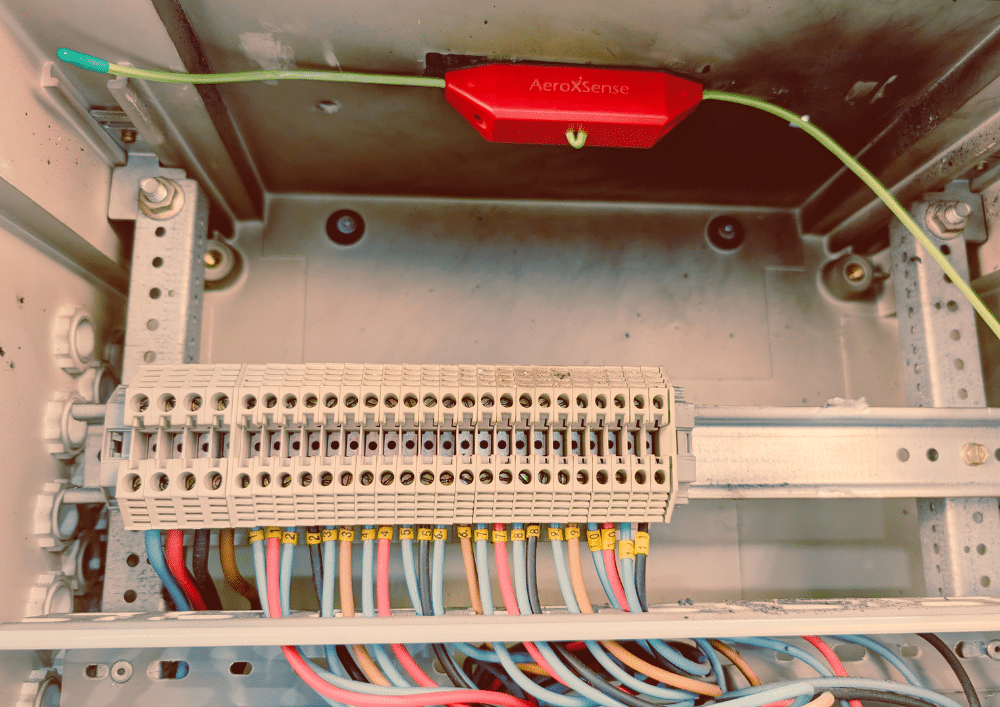
Larger enclosures require a Pro or Industry solution and a detection path tailored to their geometry.
AeroXSense has mastered the core of fire suppression technology
AeroXSense owns its proprietary condensed-aerosol formulation and manufactures the pellets that generate the aerosol at its own facility in Perpignan. This in-house expertise allows the company to tailor the mass, format, and behavior of the extinguishing agent to compact products designed for electrical panels.
The fire-suppressing agent is manufactured by AeroXSense at its facility in the Pyrénées-Orientales.
Understanding, Choosing, and Installing Your System
Find additional resources for resellers, electricians, and installers.
How the Aerosol Works
Understanding how condensed aerosol is generated and interrupts the chemical reaction in the flame.
Understanding the TechnologyInstructions for Use
See the instructions for preparation, installation and inspection of the electrical panel.
Read the instructionsThe three product lines
Compare Habitat, Pro and Industry applications according to the project and equipment type.
Compare product linesBecome a partner
Get the terms and conditions, documentation, and sales information.
Become a resellerAutomatic Fire Suppression System for Electrical Panels
How does a fire suppression system for an electrical panel work?
The system detects a rise in temperature in the panel; automatically activates a generator and releases a condensed aerosol. The agent primarily acts on the chemical reaction of the flame.
Which model should I choose for my electrical panel?
The choice depends on the width of the panel, the number of modules, the number of rows, the interior volume, and the available installation space. The 4-, 8-, 12- and 18-module configurations are provided as general guidance.
Can the Habitat line protect a professional electrical panel?
Yes, when it comes to a small panel or enclosure whose width, volume, and configuration are compatible. Larger or more complex equipment should be considered for the Pro or Industrial line.
Does this device replace a portable fire extinguisher?
No. AeroXFireshield provides automatic, localized protection. It does not replace first-response measures, regulatory requirements, or the site’s fire procedures.
Is a power supply required to activate the Habitat line?
The detection and activation mechanism for the standalone version of does not rely on the panel's power supply. However, please refer to —the user manual for the installed model—to determine its exact configuration.
Where should the device be installed in the panel?
It is generally placed at the top, in the direction indicated, on a clean, prepared surface. The outlet must not be obstructed, and the detection must cover the high-risk areas.
Can a photovoltaic enclosure be protected using the Habitat line?
Some small enclosures may be compatible. Larger enclosures—whether ventilated, compartmentalized, or featuring multiple connection zones —should be evaluated using the Pro or Industry product lines.
What solution should be used for an electrical cabinet?
Electrical cabinets generally fall within the Pro or Industry ranges,, which offer broader linear detection ranges and capabilities suited for larger spaces.
What solution should be used for an electrical room?
An electrical room requires a room-scale study,, using an industrial design approach that takes into account the overall volume,, the existing cabinets, ventilation, and protection objectives.
What should you do after activating the system?
The system must remain de-energized until it is inspected. The cause of the fire must be identified, the equipment inspected, and the area cleaned in accordance with the appropriate procedures before the system is put back into service.
Do you have an electrical panel or enclosure to protect?
Please send us the width, interior dimensions, number of rows, and a few photos. We’ll guide you toward the Habitat line or a Pro solution if the configuration requires it.