Fire suppression system for an electrical cabinet
AeroXFireshield automatically detects and suppresses a fire directly inside the electrical cabinet. Linear thermal detection follows the risk areas, while condensed aerosol acts close to the components to limit fire spread, equipment damage and production downtime.
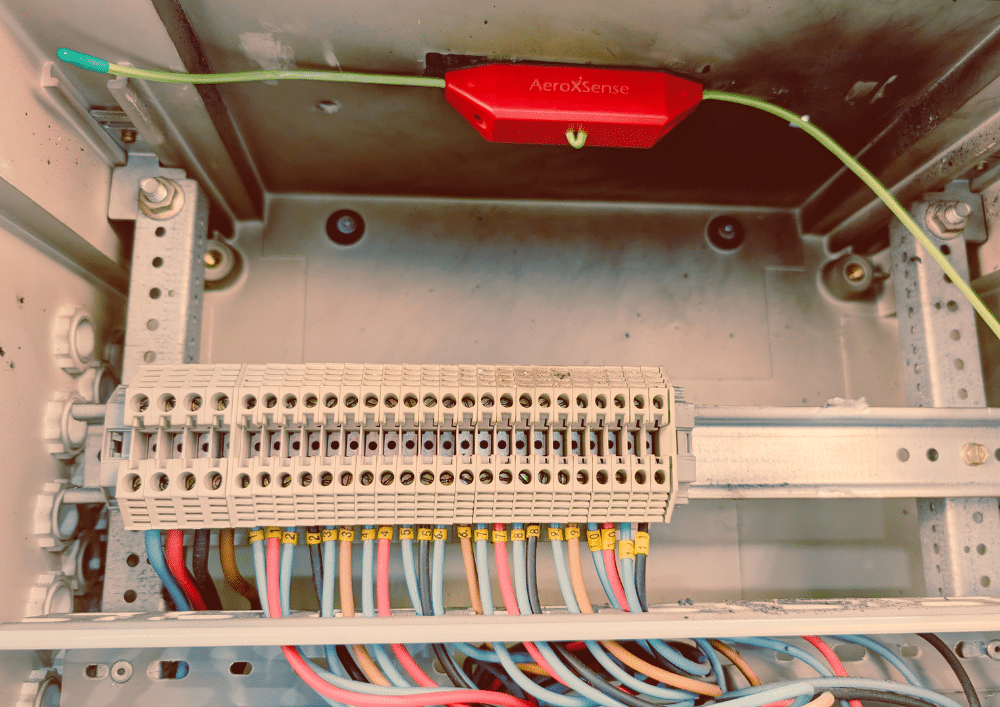
Automatic protection integrated into a professional electrical cabinet with linear detection adapted to the enclosure geometry.
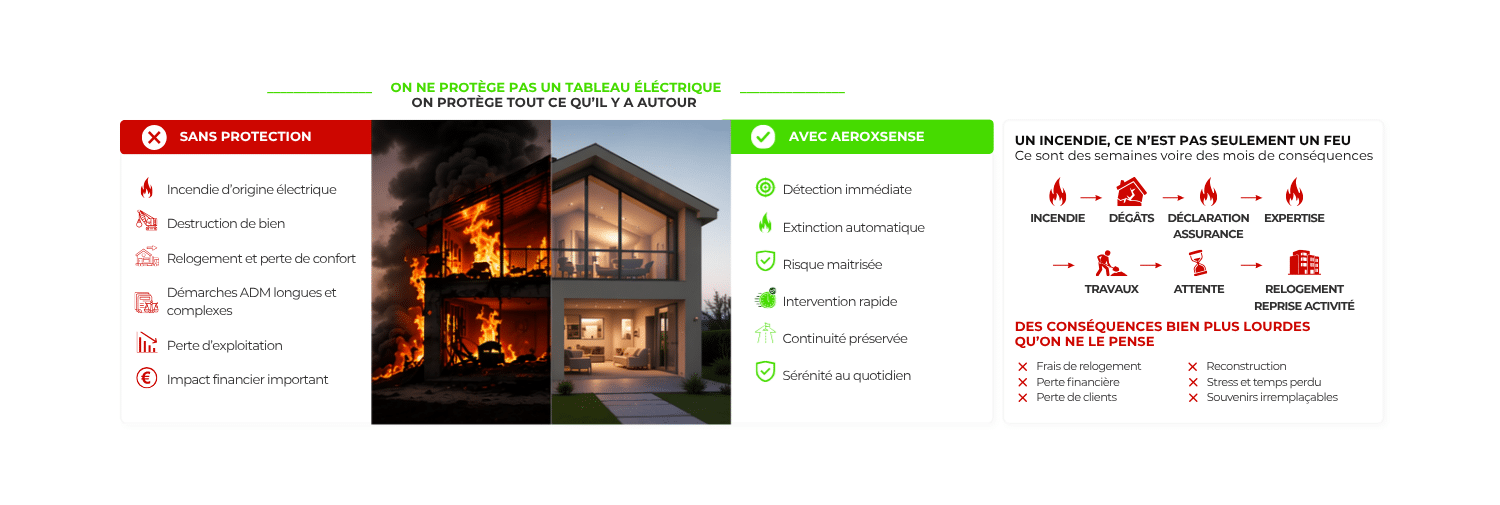
Why protect an electrical cabinet?
An electrical cabinet contains power, control and protection equipment. A hidden fault can cause overheating, arcing or ignition and stop a machine, production line or entire site.
Connection overheating
Loose tightening, oxidation or contact resistance may create a progressive hot spot.
Electrical arc or short circuit
Insulation damage, component failure or arcing may ignite nearby materials.
Component failure
Power supplies, relays, contactors, drives, transformers or PLCs may become the source of a fire.
Spread through cabling
Conductors and cable routes may carry fire into other compartments or equipment.
Harsh environment
Dust, vibration, humidity, heat and corrosion accelerate ageing.
Business interruption
Loss of a strategic cabinet may stop production far beyond the cost of the equipment.
Why act directly inside the cabinet?
Protecting the enclosure allows the system to act close to the fire source. Whole-room protection addresses a different objective and may be complementary.
In-cabinet protection
Detection above the components and aerosol distribution inside the enclosed volume.
- Early action inside the equipment
- Agent quantity matched to the internal volume
- Reduced risk of spread outside the cabinet
Electrical-room protection
An architecture engineered for the room and all installed equipment.
- Consideration of total room volume
- Assessment of openings and ventilation
- Suitable for hazards located outside cabinets
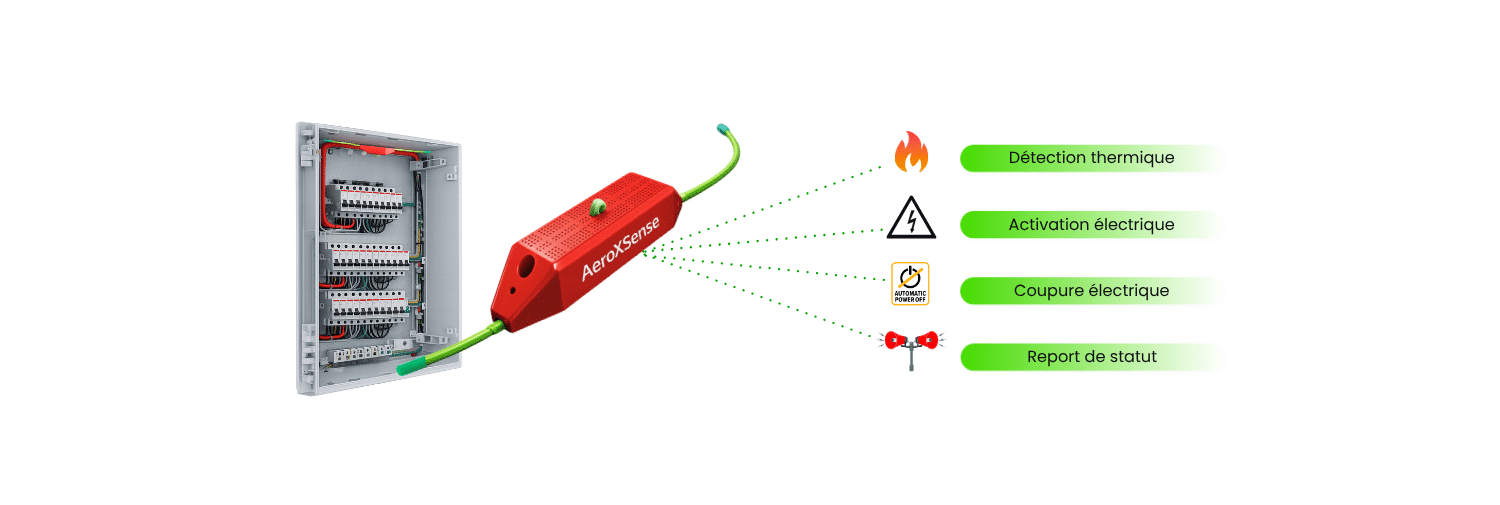
Detect, activate and interrupt combustion
AeroXFireshield combines linear thermal detection with a self-contained condensed-aerosol generator.
Monitoring risk areas
The heat-sensitive cable runs above terminals, connections and strategic components.
Thermal activation
When the local activation temperature is reached, the generator starts automatically.
Aerosol generation
The solid formulation becomes a cloud of active particles distributed inside the enclosure.
Flame interruption
The particles mainly interrupt the chemical chain reaction that sustains combustion.
The consequences of fire often extend beyond the cabinet
An electrical fire may cause equipment damage, long replacement times, lost production and prolonged site shutdown.
Monitoring that genuinely follows the components
A point sensor measures temperature in one place. Linear detection can follow several areas of the cabinet and respond close to the hot spot.
Above terminal blocks
The cable can be positioned close to connections where many overheating events begin.
Across several rows
An S-shaped path covers several levels instead of monitoring only the top of the cabinet.
Adapted to geometry
Length and routing can be adjusted around compartments, obstacles and power zones.
Capacities for professional and industrial cabinets
Models are selected according to protected volume and actual configuration. Several generators can be combined for large or compartmented cabinets.
Up to 150 L
Small control cabinets, professional enclosures and compact equipment.
Up to 350 L
Automation cabinets, small power enclosures and technical installations.
Up to 450 L
Medium-sized electrical cabinets and industrial equipment.
Up to 600 L
Power, process and photovoltaic cabinets.
Up to 750 L
Large industrial cabinets or high-density configurations.
Up to 1,050 L
Large electrical enclosures and critical technical cabinets.
Up to 1,200 L
Very large cabinets or volumes requiring increased capacity.
Above 1,200 L
Combination of several units and detection adapted to compartments.
How do you select the correct model?
Volume is necessary for the calculation, but it does not by itself ensure rapid detection or correct aerosol distribution.
Internal dimensions
Measure the actual available width, height and depth.
Compartments and partitions
A separation may prevent heat or aerosol from circulating freely.
Ventilation
Air inlets, fans and extraction affect agent retention.
Equipment density
Obstacles and cabling may modify the aerosol distribution path.
| Configuration | Range guidance | Detection to assess | Essential checks |
|---|---|---|---|
| Small cabinet or professional enclosure | AX150M to AX350M | Cable above the main terminal blocks | Net volume, width, closure and available space |
| Medium industrial cabinet | AX450M to AX750M | Several levels or S-shaped path | Compartments, ventilation, obstacles and power zones |
| Large electrical cabinet | AX1050M to AX1200M | Extended route and multiple areas | Volume, depth, density, openings and aerosol circulation |
| Compartmented cabinet or very large volume | Multi-generator architecture | Separate detection by area where required | Full assessment of each compartment and activation logic |
Which electrical cabinets can be protected?
The solution can be integrated into many electrical enclosures where the hazard, volume and installation conditions are compatible.
Automation cabinets
PLCs, relays, power supplies, circuit boards and control systems.
Main switchboards and power
Distribution, critical feeders, protection devices and busbars.
Photovoltaic systems
AC/DC enclosures, protection, monitoring and conversion cabinets.
EV charging
Distribution cabinets and equipment associated with charging stations.
Telecommunications
Network equipment, backed-up power and technical cabinets.
Industrial process
Drives, automation and machine control.
Pumping and water treatment
Control cabinets, motors, stations and isolated equipment.
HVAC and BMS
Control of ventilation, heating, cooling and building supervision.
Marine and ports
Cabinets exposed to humidity, vibration and corrosion.
Infrastructure
Transport, logistics, tunnels, technical sites and critical equipment.
Data and servers
Compatible IT racks and cabinets requiring local protection.
Special-purpose machinery
Protection integrated close to production equipment.
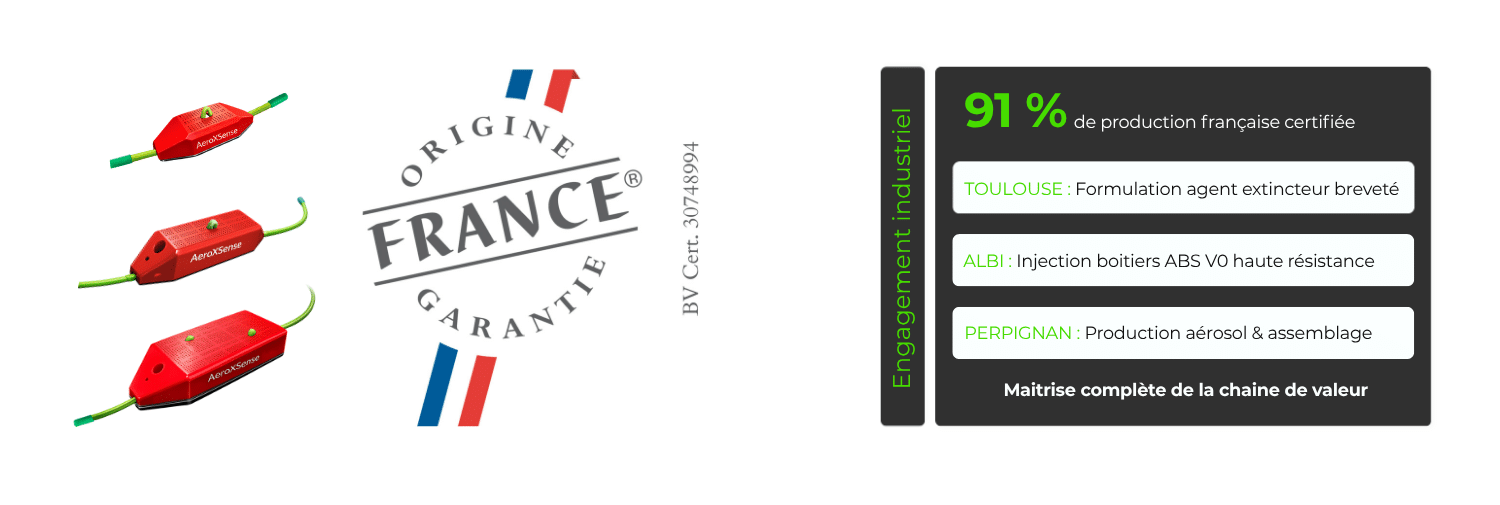
Technology designed and manufactured by AeroXSense
AeroXSense controls its condensed-aerosol formulation and manufactures the generating pellets in its own facility. This expertise allows the agent quantity, device format and discharge behaviour to be adapted to small electrical volumes.
Aerosol, gas, water or portable extinguisher?
Each technology has a different scope. For an enclosed cabinet, condensed aerosol provides automatic, compact and directly integrated protection.
| Criterion | AeroXFireshield | Centralised gas system | Water or water mist | Portable extinguisher |
|---|---|---|---|---|
| Automatic action in the cabinet | Yes | Possible with dedicated pipework | Rarely suitable inside | No |
| Cylinder and pipework | No | Yes | Often | No |
| Action close to the fire source | Yes | Depends on installation | Variable | After human detection |
| Installation work | Limited | Extensive | Extensive | Very limited |
| Protection without human presence | Yes | Yes | Yes, depending on system | No |
| Suitability for small volumes | Very favourable | Often complex | Poorly suited | Operator-dependent |
From assessment to 24/7 protection
Explore your fire-protection project
Electrical panels
Compact Habitat solutions for residential panels and small enclosures.
Electrical rooms
Whole-room architecture for several cabinets and large volumes.
How aerosol works
Understand aerosol generation and its action on combustion.
Habitat, Pro and Industry ranges
Compare product families by volume and application.
Frequently asked questions about electrical-cabinet fire protection
How can an electrical cabinet be protected against fire?
Prevention combines correct electrical design, regular maintenance, overheating monitoring and, where justified by risk, automatic detection and suppression inside the cabinet.
Which automatic extinguisher should be used in an electrical cabinet?
Selection depends on internal volume, width, compartments, ventilation, equipment and the detection path. A model should not be chosen from the stated volume alone.
Can an existing electrical cabinet be retrofitted?
Yes, where a compliant installation position is available, the door can still close and detection can cover the risk areas. The configuration must be checked first.
Why use linear thermal detection?
It can follow several terminal blocks and components over a defined length, making it less dependent on the position of a single point sensor.
Does condensed aerosol damage electrical equipment?
Any activation requires inspection, appropriate cleaning and restoration before restart. The primary objective is to interrupt the fire and prevent much greater damage.
Does the system require the cabinet power supply?
The self-contained thermal detection and activation version does not depend on cabinet power. Monitoring, signalling or controlled options may use a different architecture.
How is a compartmented cabinet protected?
Each compartment must be treated as an area that may restrict detection and aerosol movement. Several cable routes or generators may be needed.
Can a ventilated cabinet be protected?
In some configurations, yes. Fans and openings affect agent concentration, so shutdown, closure or additional capacity may need to be assessed.
What maintenance is required?
Visual checks, fastening inspection, detection-cable condition, product integrity and replacement date must follow the instruction manual and the site maintenance plan.
Can a photovoltaic cabinet be protected?
Yes where volume, geometry, compartments and ventilation are compatible. DC hazards, batteries and conversion equipment must be identified separately.
Can a main low-voltage switchboard be protected?
Yes, but it may contain several cells and separated volumes. Each compartment, busbar area, feeder and activation logic must be assessed.
What is the difference between cabinet and room protection?
Cabinet protection acts inside the enclosure. Room protection treats the whole volume and hazards outside cabinets. The two approaches may be complementary.
Do you have an electrical cabinet to protect?
Send us the internal dimensions, photographs, number of compartments, ventilation information and a list of the main equipment. We will determine the suitable model, detection route and system architecture.
